While Other Cities React, Amsterdam Already Knows What will Break Next
 by
by 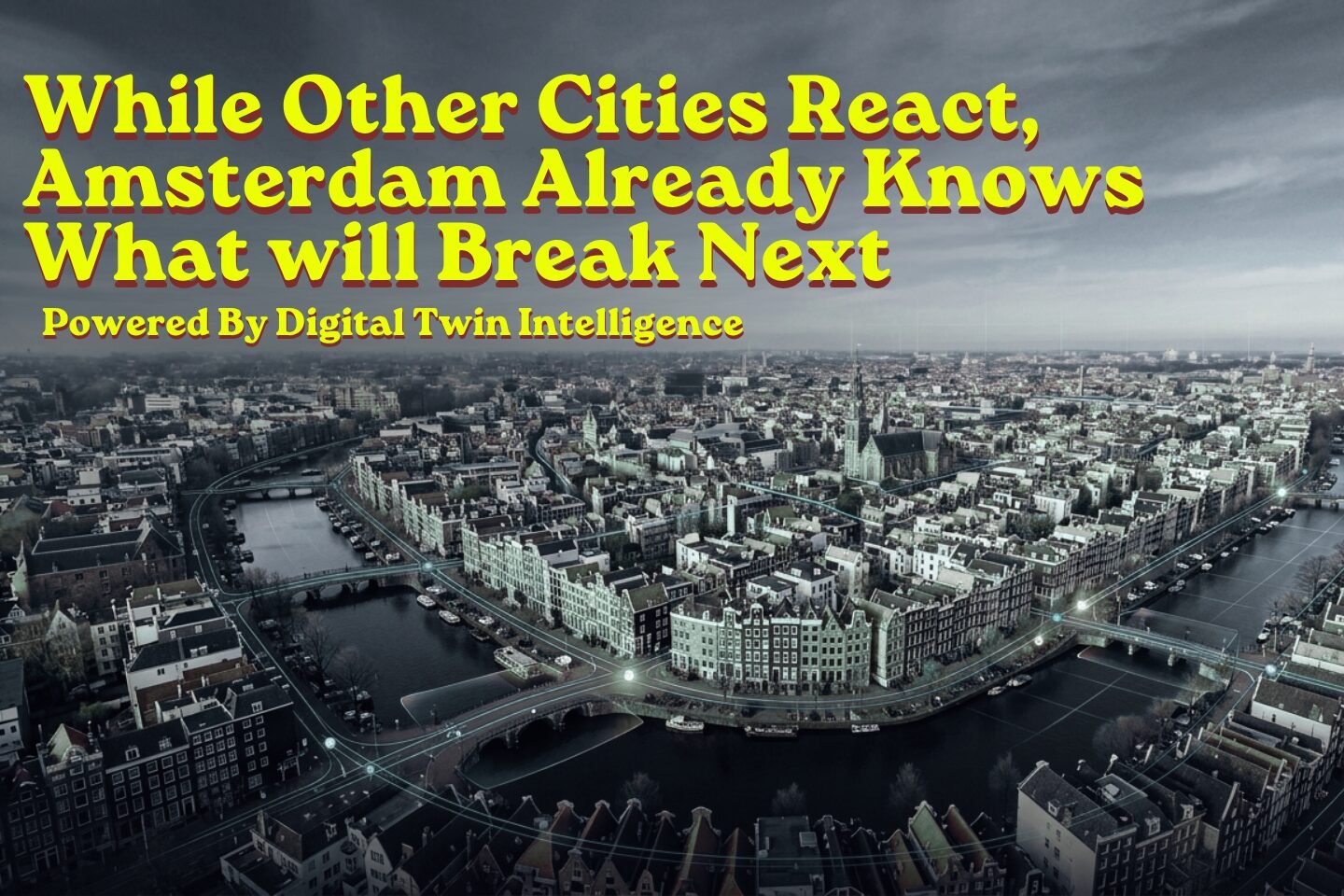
Most cities don’t see problems coming. They feel them.
Traffic doesn’t start as chaos.
It builds… slowly… quietly… until everything stops.
Infrastructure doesn’t fail overnight.
It weakens in silence… until something breaks.
Energy systems don’t collapse instantly.
They stretch… overload… and then give in.
And only then do cities react. They fix what’s already broken. They manage what’s already out of control. They respond after the damage is done. That’s how cities have always worked, and that’s exactly the problem.
Amsterdam refuses to play that game.
It’s not trying to react faster.
It’s not trying to fix things better.
It’s asking a completely different question:
“What’s about to go wrong?”
Powered by Digital Twin and predictive analysis, the city has built something radical — a living digital replica that thinks ahead.
It watches patterns. It detects signals. It simulates outcomes before reality catches up. So traffic is managed before it builds. Infrastructure is repaired before it fails. Energy is optimized before it breaks.
This is not smart city technology.
This is something else entirely.
This is a city that doesn’t wait for problems.
It predicts them.
Understanding the Digital Twin Model in Amsterdam
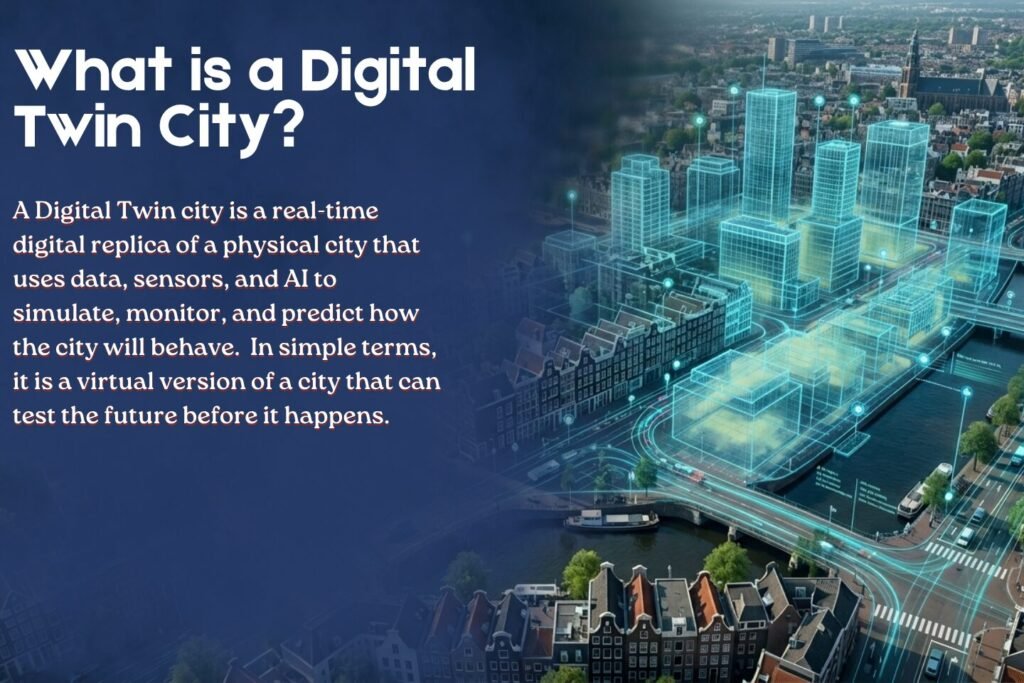
A digital twin is not a mere dashboard.
Nor it is a simple visualization layer.
It is a dynamic model that constantly evolves.
At Amsterdam, every vital urban component including transportation network and energy grid exists in digital space at the same time. The urban digital twin receives live data from various sensors and IoT devices. Yet, the real power of Digital Twin comes into action after. With the help of predictive analysis, this system not only reflects the current state but also predicts it. Because of the Digital Twin, real-time simulation turns into a revolution.
Instead of asking “What has happened?”
Now, Amsterdam can ask, “What will happen in case of…”
The Truth Most Cities Are Missing
Most cities underestimate the significance of Digital Twin technology in modern urban spaces. Without this technology, they remain reactive, no matter how fast they are. Smart city solutions, data collection, and visualization alone are not enough anymore. Amsterdam has managed to create an effective predictive model.
Predicting Traffic Before It Exists
Traffic congestion has traditionally been viewed as a real-time issue. However, in a Digital Twin-powered urban system, it becomes predictive. By running real-time simulation models, Amsterdam can forecast the traffic situation a few hours ahead of time. The city is able to run simulation models of how changes in weather conditions and major events affect the entire city’s traffic network. Urban simulation proves that predictive traffic management solutions help to decrease traffic congestion by 20–30%.
Preventing Infrastructure Failures Before They Happen
Failure of urban infrastructures leads to losses, inconveniences, and disruptions. In Amsterdam, digital twins constantly monitor urban infrastructure such as bridges, pipelines, roads, etc., receiving information about stress patterns and environmental impact. Because of predictive analysis, the digital twin system detects early warning signs of infrastructural damage prior to its manifestation. Predictive maintenance helps to save the city from infrastructural failure in about 30–50%. In such a way, the city can:
- Plan preventive measures timely
- Schedule maintenance works efficiently
- Minimize risks of catastrophes.
Transforming Energy Systems with Predictive Intelligence
Energy management is one of the most complex processes in urban systems. Demand varies, supply is inconsistent, and waste is inevitable. But all these factors may be predicted using digital twins. The Amsterdam urban model uses predictive analysis for real-time forecasts of energy consumption in particular zones within the city. Running real-time simulations, it forecasts spikes in consumption and adjusts distribution strategy consequently. Consequently, it results in:
- Reduced energy waste
- Improved renewable energy integration
- Sustainability
All the trends prove that such an approach becomes vital nowadays due to the need to achieve net-zero goals.
What This Means for Businesses and Governments
The benefits are not limited to urban infrastructure. Companies that adopt digital twins and predictive technologies can:
- Anticipate problems
- Improve operations
- Take quicker and data-backed decisions
Those who won’t make such decisions will stay behind. The question is not about
“Do I have to create digital twins?” But about “How many miles I’m lagging?”
Final Insight: The Shift from Smart to Predictive
For decades, creating “smart” cities has been our target. But Amsterdam proves that something even better exists. Namely, predictive approach. All because of the adoption of digital twins, Amsterdam can move from solving problems to predicting them prior to any issues occurring. As this model expands globally, one truth emerges clearly:
The future will not belong to cities that can respond quicker.
It will belong to those predicting better.
FAQ's
Unlike traditional smart cities, Amsterdam's Digital Twin is capable of real-time simulation along with predictive analysis. Rather than just reacting to incidents, this technology predicts upcoming issues, making Amsterdam one of the most advanced implementations of urban digital twins globally.
The predictive analysis of the city's Digital Twin is used to analyze and simulate future scenarios based on real-time data. Thus, the Amsterdam Digital Twin allows the city to avoid traffic jams, infrastructure failures, and energy inefficiencies.
The Digital Twin technology creates a virtual twin of any physical system. As far as Amsterdam is concerned, the urban digital twin is used to mirror city infrastructure and predict potential scenarios.
Absolutely. The implementation of Digital Twin technology and predictive analysis within it helps identify early warning signs in the city's infrastructure systems. Thus, failures can be avoided, and performance improved.
Digital Twin technology in Amsterdam allows predicting the traffic flow and optimizing traffic management with real-time simulations. It means that any potential traffic jams are predicted and resolved even before they occur.
While traditional smart cities focus on monitoring, Digital Twin and predictive analysis allow cities to simulate their decisions and anticipate potential problems. Therefore, this technology will be crucial in the future of smart cities.
Digital Twin Summit Netherlands brings industry-leading speakers and participants from all around the globe who aim to find out how Digital Twin and predictive analysis impact our future.
Yes, Amsterdam has already managed to become more energy-efficient using predictive analysis, which allows the city to forecast any changes in energy demand and distribute resources effectively.
Yes. Other industries could use the Amsterdam Digital Twin model as inspiration for implementing Digital Twin and predictive analysis into their systems. This way, many industries would be able to operate even more efficiently.
Yes. Amsterdam becomes one of the leading urban cities when it comes to implementing innovative technologies such as Digital Twin.
Amsterdam is developing a model of a predictive city that makes it attractive for investors. Digital Twin Summits organized in the Netherlands unite leaders and discuss how to use this solution in various industries including logistics, manufacturing, construction, and urban development.