The Hospital Was Already Automated. So Why Did It Still Need a Digital Twin?
 by
by 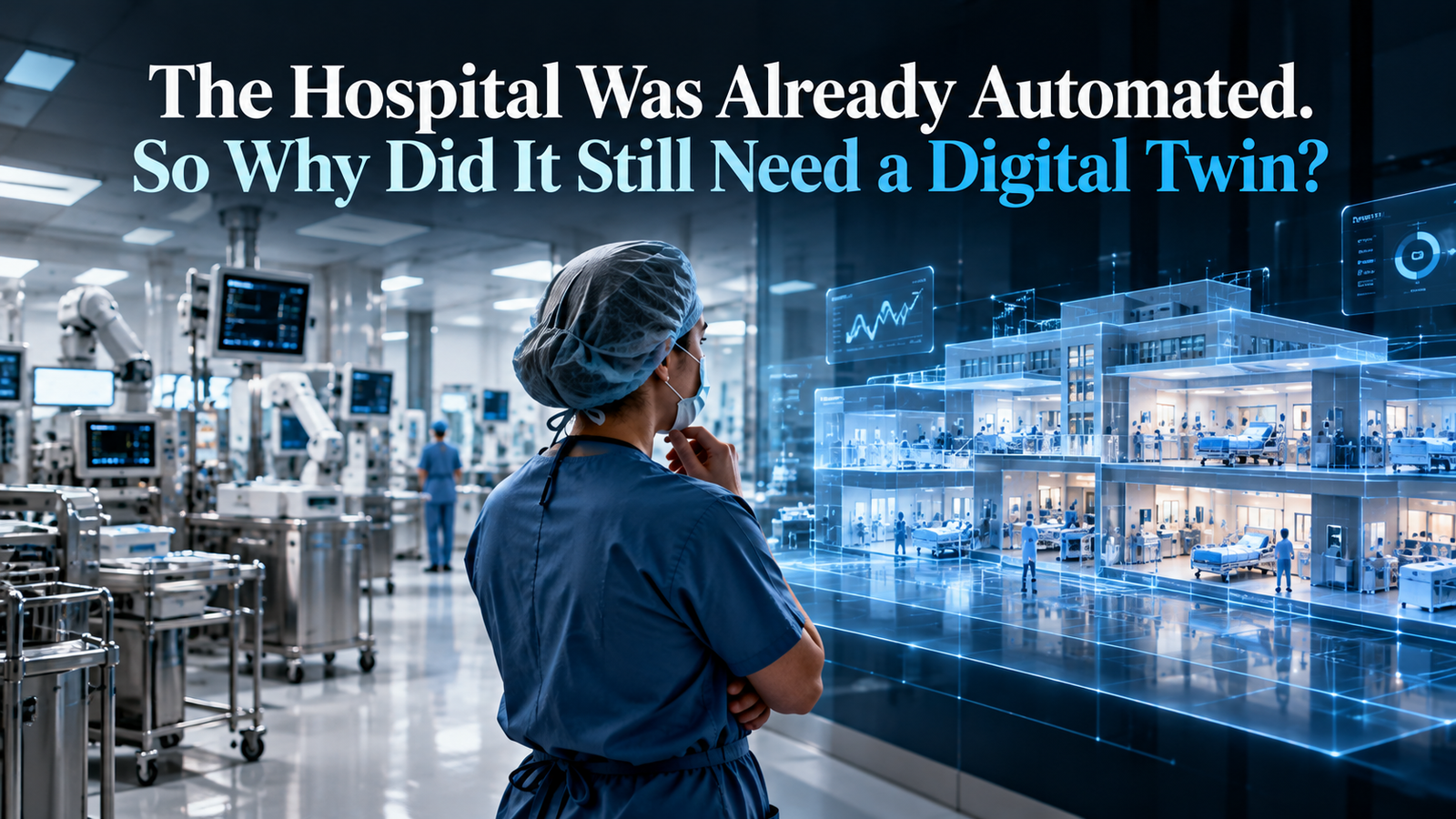
What if a hospital could discover the cause of an operational delay, test a solution and evaluate its impact before changing the real facility?
That is the promise of a digital twin, and SAS is demonstrating how it can work in one of healthcare’s most operationally critical environments: surgical instrument sterilisation.
On October 6, 2026, SAS was recognised in Fast Company’s Next Big Things in Tech 2026 list in the Applied AI category for its work with Sterilcentral, Denmark’s largest medical sterilisation provider. The facility supports approximately 1,000 surgeries daily across seven hospitals in Denmark’s capital region.
The project offers a powerful example of how digital twin healthcare technology can improve the systems behind patient care, without attempting to diagnose or treat patients directly. It also reveals a broader opportunity for hospitals, healthcare logistics providers and industrial operators: use simulation to identify bottlenecks, test operational decisions and reduce uncertainty before making changes in the real world.
Why a sterilisation bottleneck can become a hospital-wide problem
Surgical instruments must move through a carefully coordinated sequence of washing, drying, packaging and delivery before they are ready for use. A delay at one stage can affect the availability of instruments further downstream, potentially disrupting operating schedules.
Sterilcentral’s automated facility handles thousands of instruments across this process. Because its operations support seven hospitals, a disruption is not merely a local efficiency problem. It can affect the wider network of healthcare services that depends on reliable instrument availability.
This is where digital twin logistics becomes particularly valuable. Instead of examining each process in isolation, operators can model how materials move through the system, where inventory accumulates and how one constraint affects the stages that follow.
How SAS built the hospital digital twin
SAS created a digital twin of key parts of Sterilcentral’s Herlev facility using SAS Viya and Epic Games’ Unreal Engine. The system combines a detailed three-dimensional virtual environment with operational data, analytics, machine learning and simulation.
The distinction between a 3D model and a digital twin is important. A visual replica shows what a facility looks like. A data-driven digital twin also represents how its processes behave, using operational parameters such as processing times, conveyor speeds, equipment cycles and inventory accumulation to simulate different scenarios.
SAS’s technical explanation describes a workflow that starts with analysing sterilisation-process data, identifying operational KPIs and building a high-fidelity virtual environment. Teams can then test alternative scenarios and investigate bottlenecks without making every experiment inside the live facility.
The business value is the ability to test operational decisions before committing to them.
Three ways the digital twin creates value
1. Identifying bottlenecks before changing live operations
The digital twin helps Sterilcentral investigate where delays occur across the instrument-processing workflow. Rather than relying only on assumptions about the source of a problem, teams can examine the model, simulate changes and assess how those changes may affect the overall process.
Sterilcentral CEO Thomas Bogeskov said the technology helped the organisation challenge its assumptions about where delays were occurring. He also highlighted its ability to pinpoint bottlenecks and test changes before they affect operations.
2. Improving healthcare logistics coordination
A hospital digital twin can help operators understand how individual stages influence the entire supply chain. For a facility supporting 1,000 daily surgeries across seven hospitals, reliable instrument flow is a critical operational objective.
The potential benefit is better-informed planning, fewer avoidable process disruptions and more reliable delivery of sterile instruments. However, SAS has not publicly quantified the project’s percentage reduction in delays, financial savings or improvement in surgery start times. Those outcomes should not be assumed from the recognition alone.
3. Training computer vision with synthetic data
The project extends beyond process simulation. SAS and Sterilcentral also used the virtual environment to generate synthetic data for training computer vision models that help identify whether workers are wearing protective equipment correctly, supporting contamination-risk reduction.
Synthetic data is valuable when collecting and labelling sufficient real-world examples is difficult. A realistic virtual environment can generate additional training scenarios, although the resulting models still require appropriate validation against real-world conditions before operational use.
This makes the project especially interesting: one digital twin supports both operational optimisation and AI model development.
What healthcare leaders should measure
Implementing a digital twin is not the end goal. The objective is measurable operational improvement.
Healthcare organisations evaluating a digital twin healthcare project should establish baseline measurements and track changes over time.
KPI | What it reveals |
Instrument processing time | How long instruments take to move through the workflow |
Bottleneck waiting time | Where work accumulates and delays emerge |
Equipment utilisation | Whether machines and processing capacity are being used effectively |
On-time instrument availability | Whether hospitals receive required instruments when needed |
Disruption frequency | How often operational interruptions affect the process |
PPE detection accuracy | How reliably computer vision identifies protective-equipment compliance |
Scenario-to-decision time | How quickly teams can evaluate alternatives and make informed decisions |
These are recommended evaluation metrics, not published results from the Sterilcentral project. Establishing baselines and validating improvements is essential to demonstrate return on investment.
Where digital twin healthcare goes next
The same approach could be relevant to hospital supply chains, pharmacy distribution, medical-device manufacturing, laboratory workflows and other operations where delays, capacity constraints and safety requirements interact.
The principle extends beyond healthcare. Manufacturers, logistics providers and infrastructure operators can use digital twin logistics to model complex workflows, test operational changes and identify constraints before implementing them in live environments.
The opportunity is not to simulate everything. It is to identify the decisions where testing first in a virtual environment can reduce risk, improve planning or reveal a problem that conventional reporting might miss.
What this means for the Digital Twin Summit community
The Sterilcentral project illustrates an important evolution in enterprise simulation: digital twins are becoming decision-support environments, not just visual representations of physical assets.
For the Digital Twin Summit community, the case raises practical questions about integrating operational data, building trustworthy simulations, validating AI models and proving business value. These are the capabilities organisations need when moving from a promising demonstration to a dependable operational system.
The broader lesson is that digital twin technology can create value even when it never touches a patient’s clinical record. By improving the infrastructure that supports care, it can help organisations make better decisions about capacity, process flow, equipment and safety.
Conclusion: The smartest hospital upgrade may happen before anything changes
SAS and Sterilcentral demonstrate how a hospital digital twin can help teams investigate bottlenecks, simulate operational changes and generate synthetic data for computer vision training. The project supports an operation serving approximately 1,000 surgeries a day across seven hospitals, making reliability a network-wide concern rather than a narrow facilities issue.
The next step for organisations considering this technology is to identify one high-impact workflow, establish measurable baselines, validate the model against real operational data and track outcomes after changes are implemented. Without that discipline, a digital twin risks becoming an impressive visualisation with unclear business value.
The real breakthrough is not building a virtual hospital. It is discovering what needs to change before changing the real one.
For healthcare, manufacturing and logistics leaders exploring that opportunity, the Digital Twin Summit` conversation should focus on practical implementation, trustworthy simulation and measurable operational outcomes. The Sterilcentral case provides a concrete starting point for that discussion.
FAQ's
A hospital digital twin models real-world processes using operational data, allowing teams to simulate scenarios, identify bottlenecks and evaluate potential changes before implementing them. At Denmark's Sterilcentral facility, SAS used a digital twin to investigate surgical instrument flow and improve the reliability of sterilisation operations supporting approximately 1,000 surgeries daily across seven hospitals.
SAS and Sterilcentral used operational data and simulation to challenge assumptions about where delays occurred in the sterilisation workflow. The analysis highlighted the importance of examining inventory accumulation and downstream process flow rather than assuming that the longest processing stage was necessarily the main bottleneck.
A digital twin in healthcare is a data-driven virtual representation of a physical asset, facility or operational process. It allows healthcare organisations to analyse performance, simulate changes and investigate potential improvements without relying exclusively on experiments in live environments.
A 3D hospital model primarily represents the appearance and layout of a facility. A hospital digital twin combines a virtual representation with operational data, process behaviour and simulation, enabling teams to investigate how the system works and assess potential changes.
Digital twin logistics helps healthcare operators model how materials, equipment and inventory move through interconnected workflows. By identifying congestion, resource constraints and waiting times, organisations can evaluate ways to improve throughput, equipment utilisation and the availability of essential supplies.
SAS and Sterilcentral used the virtual environment to generate synthetic images for training computer vision models that identify whether workers wear required personal protective equipment. Synthetic data can increase training-data variety and reduce dependence on manually labelled real-world images, although models still require appropriate validation against real conditions.
The project combines SAS Viya with three-dimensional environments created using Epic Games' Unreal Engine. SAS describes an approach that integrates operational analytics, machine learning, simulation and synthetic data generation to investigate process bottlenecks and support computer vision development.
Healthcare organisations can evaluate instrument turnaround time, inventory waiting time, equipment utilisation, on-time supply availability, disruption frequency and resource requirements. These metrics should be measured against a baseline to establish whether the digital twin leads to measurable operational improvements.
Yes. Digital twin technology can support manufacturing, warehouses, transportation, energy and supply chains by modelling complex processes and evaluating operational changes. The Sterilcentral project also demonstrates how one virtual environment can support both workflow optimisation and AI model development.
Organisations should identify a high-impact operational problem, establish reliable data sources, define measurable KPIs and validate the model against actual system behaviour. They should also assess integration costs, model maintenance, simulation accuracy and the business impact of decisions made using the digital twin.