Digital Twin Is No Longer the Future. It Is Becoming the Operating System of Modern Industry
 by
by 
Key Insights from the Digital Twin Tech Summit 2026 That Every Business Leader Should Know
For years, Digital Twins were viewed as experimental initiatives, impressive demonstrations that lived inside innovation labs and pilot projects.
That perception has fundamentally changed.
Across manufacturing plants, smart cities, energy networks, healthcare infrastructure, and public sector operations, Digital Twins are rapidly evolving into mission critical business systems that enable organizations to make faster, smarter, and more resilient decisions.
During the 3rd Annual Digital Twin Tech Summit 2026 in Amsterdam, global technology leaders, municipal innovators, industrial pioneers, and enterprise executives gathered to discuss the next phase of Digital Twin adoption. Over two days of keynote sessions and industry discussions, one message consistently emerged:
Organizations that successfully combine Digital Twins, AI, interoperability, and governance will define the next era of industrial competitiveness.
Having closely analyzed the keynote discussions, speaker presentations, and recurring themes throughout the summit, several strategic trends became evident. These insights provide a practical roadmap for organizations seeking to move beyond experimentation and unlock measurable business value from Digital Twin initiatives.
The Most Important Insights from the Digital Twin Tech Summit 2026
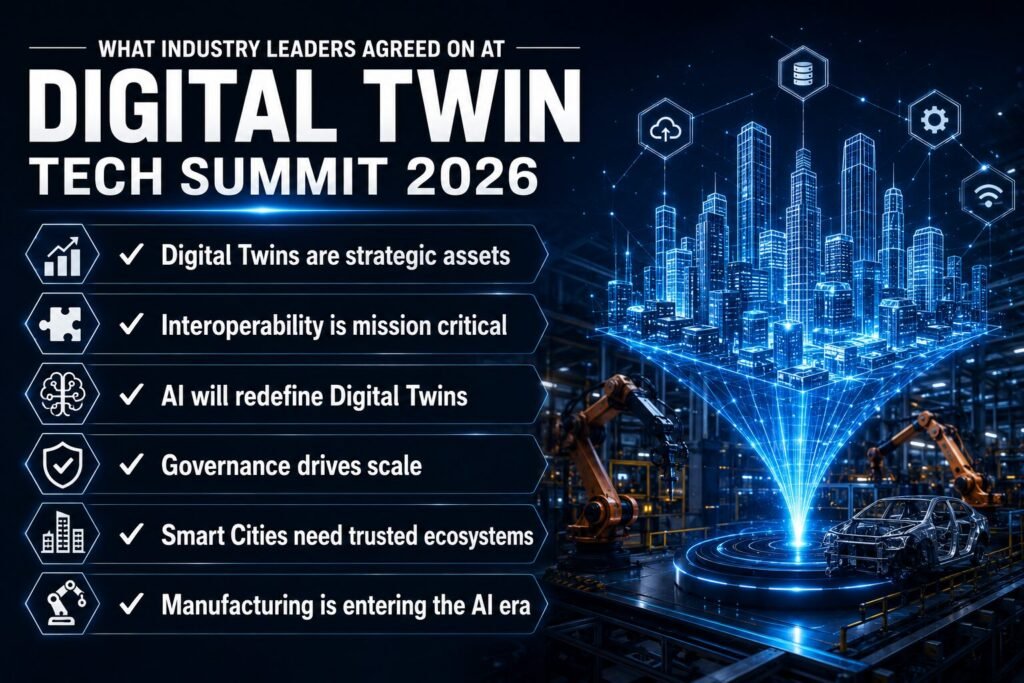
1. Digital Twins Have Evolved from Engineering Projects into Strategic Business Platforms
One of the most significant themes observed throughout the summit was the transition of Digital Twins from technical initiatives to enterprise wide strategic assets.
The opening keynote by Asif Kabani, Senior Fellow and Executive Director at the UN SDG Centre Geneva, highlighted how Digital Twin technologies are increasingly supporting sustainable industrial transformation and accelerating progress toward the United Nations Sustainable Development Goals. The discussion demonstrated that Digital Twins are no longer limited to operational efficiency. They are now enabling organizations to improve resilience, sustainability, and long term business continuity.
A recurring discussion among industry leaders during the event was that executive leadership teams are beginning to view Digital Twins not as technology investments, but as business transformation initiatives.
Organizations that continue treating Digital Twins as isolated IT projects may struggle to realize their full value.
Why This Matters for Business Leaders
Digital Twins are increasingly influencing:
- Enterprise resilience strategies
- Sustainability and ESG initiatives
- Risk management programs
- Regulatory compliance
- Operational efficiency
- Strategic decision making
The organizations leading digital transformation initiatives are those embedding Digital Twins directly into business operations and executive decision making.
2. Smart Cities Are Entering a New Era of Data Driven Governance
Smart city innovation was one of the most discussed themes across the summit.
Several keynote sessions demonstrated how municipalities are using Digital Twins to transform urban planning, improve citizen services, and build more resilient communities.
Roland van der Heijden, Municipality of Rotterdam
In the keynote titled “From Digital Twin towards Citiverse: How to Put Humans Again in the Center of the Digital Transformation,” Roland emphasized that successful digital cities require more than technology. Trust, interoperability, and effective governance frameworks must remain at the center of every smart city initiative.
Mustafa Akpolat, Gemeente Amersfoort
Mustafa introduced the concept of the “Cognitive City,” demonstrating how municipalities can leverage data as a strategic utility to create smarter, more inclusive, and resilient urban ecosystems.
Harco de Jager, Municipality of The Hague
One of the most impactful sessions of the summit focused on how The Hague transformed its Digital Twin from a pilot initiative into a scalable governance platform that directly influences policy decisions related to climate, mobility, and spatial planning.
A clear trend emerged across these discussions.
Future cities will increasingly depend on Digital Twins to support evidence based policy making rather than reactive governance models.
Key Smart City Trends
- Real time urban simulations
- Predictive policy analysis
- Climate resilience planning
- Integrated mobility management
- Citizen centric governance
- Data driven decision making
3. Interoperability Remains the Biggest Challenge to Large Scale Adoption
While enthusiasm around Digital Twins continues to grow, speakers repeatedly highlighted interoperability as one of the industry’s most pressing challenges.
Many organizations have successfully launched pilot projects. Far fewer have achieved enterprise wide deployment.
During his keynote, Susheel Nath from FARI explained that scalable Digital Twin ecosystems require interoperable foundations, layered architectures, and robust governance models. Without these capabilities, Digital Twins risk becoming disconnected data silos that cannot deliver enterprise value.
Similarly, Mahad Nadeem Janjua from Harbour Energy emphasized the importance of open standards and ethical considerations as Digital Twin ecosystems become increasingly AI driven.
Based on discussions throughout the summit, interoperability is rapidly becoming the defining factor separating successful Digital Twin programs from unsuccessful ones.
Recommendations for Organizations
Industry leaders consistently highlighted the need for:
- Open standards
- Cross platform integration
- Standardized data models
- Clear governance structures
- Scalable architectures
Organizations that prioritize interoperability early are likely to accelerate Digital Twin adoption while avoiding costly integration challenges.
4. Generative AI Is Accelerating the Evolution of Digital Twins
Another dominant theme across the summit was the convergence of Digital Twins and Artificial Intelligence.
Several sessions explored how Generative AI is transforming Digital Twins from descriptive systems into intelligent, predictive, and increasingly autonomous decision platforms.
William Bain, ScaleOut Software
In his keynote, “Using Digital Twins to Analyze Live Systems at Scale Using Generative AI,” William Bain demonstrated how AI enabled Digital Twins can continuously analyze complex live environments, process data from thousands of sources, identify bottlenecks, and improve operational performance in real time.
Dr. Yves Gorat Stommel, Evonik
Dr. Stommel offered a balanced perspective on Generative AI and Narrow AI, highlighting that industrial organizations should focus on combining both approaches to maximize value rather than viewing them as competing technologies.
One of the strongest insights from the summit was that AI will not replace Digital Twins.
Instead, AI will significantly enhance their ability to simulate, predict, optimize, and automate complex systems.
The Next Generation of Digital Twins Will Include
- Predictive intelligence
- Autonomous decision support
- Continuous optimization
- AI assisted simulations
- Human and AI collaboration
- Real time operational analytics
5. Manufacturing Is Rapidly Transitioning Toward AI Driven Operations
Manufacturing organizations are among the most advanced adopters of Digital Twin technology.
Multiple keynote sessions demonstrated how industrial enterprises are already moving beyond visualization and embracing intelligent, data driven operations.
Michal Ukropec, Twinzo
Michal showcased how real time 3D visualization can provide holistic operational awareness, enabling organizations to improve industrial decision making across complex facilities.
Jani Akkila, Process Genius
Jani highlighted the importance of spatial intelligence and demonstrated how Digital Twins can unlock measurable gains in efficiency, operational insight, and cost optimization.
Pavel Gocev, Siemens Energy
Pavel presented one of the summit’s most forward looking visions by illustrating how AI driven factory Digital Twins, discrete event simulations, and AI in the loop manufacturing will shape the future of industrial optimization.
Across these sessions, a common conclusion emerged.
Manufacturing is moving from human supervised optimization toward increasingly autonomous and intelligent production environments.
Emerging Manufacturing Trends
- AI driven factories
- Digital manufacturing ecosystems
- Real time industrial intelligence
- Advanced simulation environments
- Scenario based optimization
- Human in the loop to AI in the loop transformation
6. Infrastructure and the Built Environment Are Undergoing Digital Transformation
Digital Twin adoption is also accelerating across infrastructure, construction, and asset intensive industries.
James Franklin, Kier Construction
James shared practical examples of how Digital Twins are improving efficiency, sustainability, and asset performance across public sector estates in the United Kingdom. His session also addressed the organizational and governance challenges associated with scaling Digital Twin programs across large infrastructure portfolios.
Mahmoud Faraj Allah, Siemens
Mahmoud explored how integrating Building Information Modeling and Digital Twins can create more sustainable and intelligent built environments throughout the entire asset lifecycle.
Jaroslaw Szczepanek, Fluor Corporation
Jaroslaw discussed how data centric execution models are helping organizations transition from traditional BIM workflows toward fully integrated Digital Twin ecosystems for managing highly complex projects.
The infrastructure sector is increasingly recognizing that Digital Twins provide a foundation for long term asset performance, sustainability, and operational resilience.
What Is the Biggest Takeaway from the Digital Twin Tech Summit 2026?
The strongest message emerging from the summit is clear:
Digital Twins are no longer optional for organizations pursuing digital transformation.
As industries continue to face growing complexity, rising sustainability expectations, and increasing pressure to improve operational efficiency, Digital Twins are becoming essential decision support systems.
Organizations that successfully combine interoperability, governance, AI, and real time analytics will be best positioned to lead the next generation of industrial innovation.
FAQ's
According to Asif Kabani from the UN SDG Centre Geneva, Digital Twins can help organizations build sustainable and resilient infrastructures by combining AI, IoT, and real time data to improve resource efficiency, reduce environmental impact, and support long term sustainability goals.
Roland van der Heijden highlighted that the Citiverse represents the next evolution of smart cities, where interoperable digital ecosystems place citizens at the center of urban transformation while ensuring trust, governance, and seamless data exchange.
Mustafa Akpolat explained that municipalities can become Cognitive Cities by treating data as a strategic utility, enabling proactive decision making, smarter public services, and improved urban resilience through Digital Twin technologies.
The biggest takeaway from the summit was that Digital Twins have evolved beyond visualization tools and are becoming enterprise wide decision engines powered by AI, interoperability, and real time analytics.
Harco de Jager showcased how The Hague uses its Digital Twin as a governance platform to support real policy decisions related to mobility, climate, energy, and spatial planning, moving beyond traditional visualization use cases.
William Bain demonstrated that combining Generative AI with Digital Twins enables organizations to continuously analyze live systems, identify operational bottlenecks, and improve decision making across thousands of real time data sources.
James Franklin shared how integrating BIM, IoT, and asset information within Digital Twin environments helps public sector organizations improve asset performance, optimize operations, and achieve sustainability objectives.
Mahmoud Faraj-Allah explained that integrating BIM with Digital Twins creates a lifecycle approach to managing built environments, enabling better collaboration, sustainability, and asset performance throughout an infrastructure project's lifespan.
Jaroslaw Szczepanek highlighted that organizations can unlock greater project efficiency by moving beyond traditional BIM workflows and adopting data centric execution models powered by Digital Twin technologies.
Pavel Gocev demonstrated that AI driven factory Digital Twins will enable simulation based optimization, scenario analysis, autonomous decision making, and a transition from human in the loop to AI in the loop manufacturing environments.