How BMW Uses Digital Twins to Optimize Production Before a Single Car Is Built
 by
by 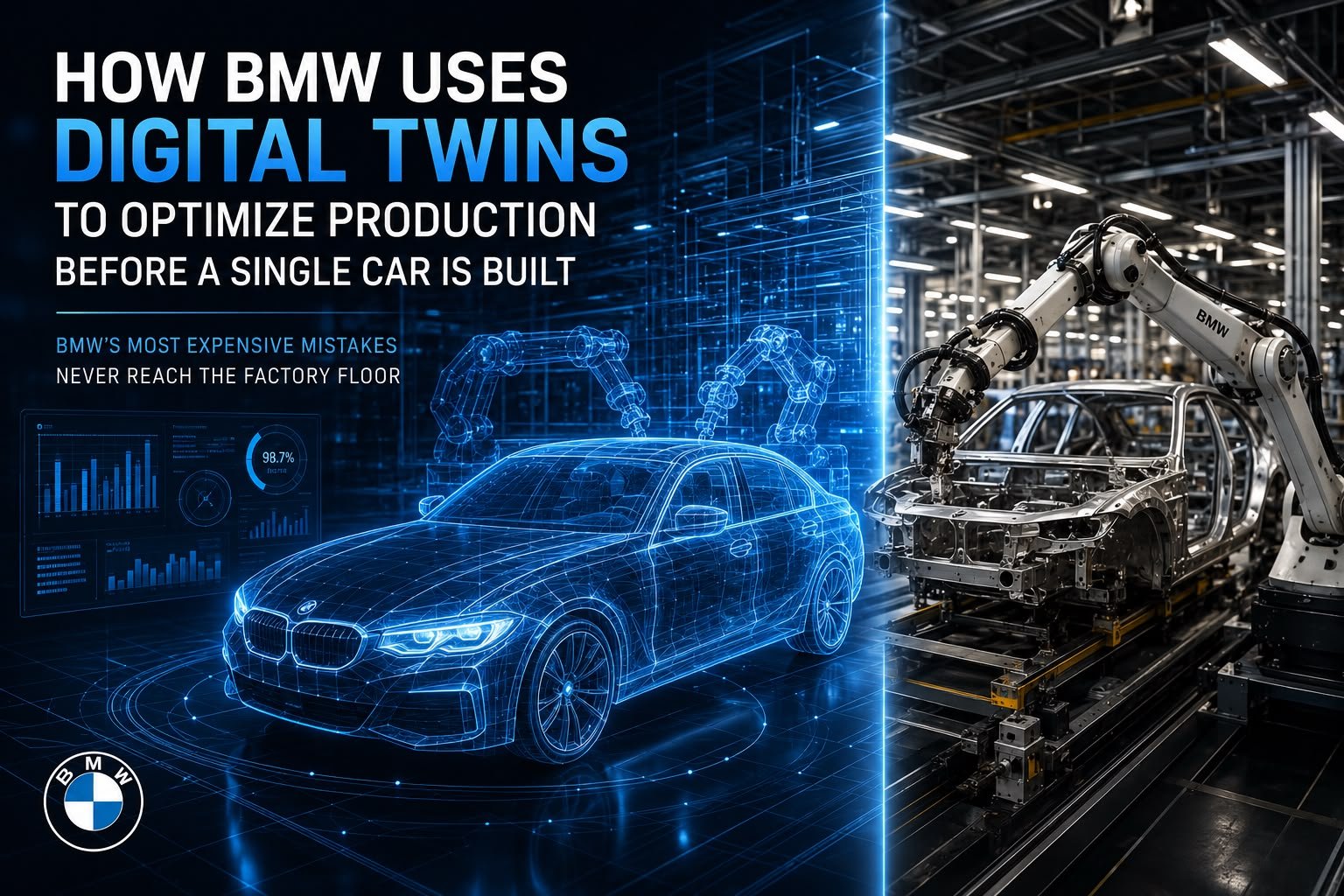
BMW’s Most Expensive Mistakes Never Reach the Factory Floor
Most manufacturers discover problems after production begins. BMW tries to discover them before a factory worker even touches a machine. That difference sounds small. It isn’t.
In automotive manufacturing, a single production bottleneck can delay thousands of vehicles. A poorly designed assembly sequence can ripple through an entire plant. A misplaced robot, inefficient workstation, or logistics constraint can cost millions before executives even realize the problem exists.
Traditionally, manufacturers accepted this reality. Build first. Test later. Fix problems as they appear. BMW decided that approach belonged to the past.
Today, before a single vehicle is assembled, before equipment is installed, and in many cases before sections of a factory are physically completed, BMW is already testing production inside a virtual world.
This is where Digital Twin technology becomes one of the most powerful competitive advantages in modern manufacturing.
Because BMW is not simply building cars. BMW is building the factory before building the factory. And that changes everything. Want to Stay ahead in Digital Twin Technology? Register For Digital Twin Summit Netherlands now!
The Hidden Problem Every Automotive Manufacturer Faces
When people think about automotive production, they usually focus on the vehicle. The reality is that manufacturing complexity begins long before the first car enters the assembly line. A modern automotive plant contains thousands of interconnected variables:
- Robots
- Conveyors
- Assembly stations
- Logistics systems
- Material flows
- Supplier inputs
- Quality checkpoints
- Worker interactions
The challenge is not designing each individual component. The challenge is making all of them work together perfectly. Historically, manufacturers only discovered many problems after production started.
A robot moved too slowly. Materials arrived at the wrong moment. Workstations created congestion. Production capacity failed to meet expectations. Every mistake carried a cost. Not just financially. Operationally. Strategically. Competitively.
This is precisely the problem BMW is solving with Digital Twin technology.
BMW's Digital Twin Strategy Starts Long Before Production
Instead of waiting until production begins, BMW creates a Digital Twin of the entire manufacturing environment.
Think of it as a living virtual replica of the factory. Not a static 3D model. Not a visualization tool. A fully interactive environment capable of simulating real-world operations before they happen. Inside this virtual environment, engineers can analyze:
- production flow
- equipment placement
- material movement
- factory logistics
- robot behavior
- workforce interactions
- assembly line efficiency
The goal is simple. Identify problems when they are still virtual. Because virtual mistakes are significantly cheaper than physical mistakes.
That single mindset shift explains why Digital Twin adoption is accelerating across advanced manufacturing environments worldwide.
BMW Is Not Using Digital Twins to Predict the Future
BMW Is Using Them to Eliminate Uncertainty Most Digital Twin discussions focus on simulation. The more important story is uncertainty reduction. Manufacturing leaders make thousands of decisions before production begins:
- Will the production line scale efficiently?
- Can robots operate without creating bottlenecks?
- Will material flow remain consistent?
- Can the factory support future vehicle models?
- Will maintenance requirements disrupt production?
Traditional planning methods often rely on assumptions.
Digital Twins replace assumptions with evidence.
- Instead of debating potential outcomes, BMW can test them.
- Instead of hoping a production design works, BMW can validate it.
- Instead of reacting to problems, BMW can prevent them.
That shift moves manufacturing from reactive decision-making to predictive decision-making. And predictive decision-making is becoming one of the defining characteristics of Industry 4.0 leaders.
Why BMW's Digital Twin Strategy Matters More in the Electric Vehicle Era
The automotive industry is experiencing its biggest transformation in decades. Electric vehicles are changing manufacturing requirements entirely. Battery systems introduce new assembly processes.
- Production lines must become more flexible.
- Supply chains are becoming more complex.
- Customer expectations continue to evolve.
In this environment, manufacturing mistakes become even more expensive. Every production delay can impact launch timelines. Every operational inefficiency can affect profitability. Every design change can create downstream consequences. Digital Twin technology gives BMW something every manufacturer wants during periods of disruption:
Confidence.
Before changing a process, BMW can simulate it.
Before redesigning a workflow, BMW can test it.
Before investing in infrastructure, BMW can evaluate outcomes.
This ability dramatically reduces risk while increasing agility.
The Real Competitive Advantage Is Not Faster Production
The Real Competitive Advantage Is Not Faster Production. It Is Faster Learning. This is where many Digital Twin articles miss the bigger story.
The greatest value of Digital Twin technology is not efficiency alone. It is learning speed.
Every manufacturer can eventually solve a problem. The companies that win solve problems before competitors even discover them. BMW’s Digital Twin environments allow engineers to explore thousands of production scenarios without disrupting operations.
Every simulation becomes a learning opportunity. Every virtual experiment generates operational insight. Every adjustment improves future decision-making. Over time, this creates something incredibly difficult for competitors to replicate:
Institutional intelligence.
The factory becomes smarter before production begins. And smarter factories consistently outperform reactive factories.
Why Manufacturing Leaders Are Paying Attention to BMW
Across manufacturing industries, leaders are facing similar pressures:
- rising production costs
- labor challenges
- supply chain uncertainty
- sustainability targets
- increasing product complexity
Traditional approaches are becoming less effective.
BMW’s Digital Twin strategy demonstrates a different path. Rather than managing complexity after it appears, BMW is designing systems capable of understanding complexity before it creates operational risk. That distinction may become one of the most important competitive advantages in modern manufacturing.
Because the future of production will not belong to companies that simply build faster. It will belong to companies that learn faster, adapt faster, and make better decisions before physical consequences occur.
Final Insight
Most manufacturers still think production begins when the assembly line starts moving. BMW understands something different. Production begins much earlier. It begins when decisions are made. And every decision carries uncertainty.
Digital Twin technology is helping BMW reduce that uncertainty before it becomes cost, delay, inefficiency, or risk.
That is why Digital Twin technology is no longer just an Industry 4.0 innovation. It is becoming a business strategy. Because in modern manufacturing, the companies that can see problems before they exist will always have an advantage over the companies that discover them after they happen.
BMW is not simply building better vehicles. It is building confidence into the production process itself.
BMW creates a Digital Twin of its factories, production lines, robots, and manufacturing workflows before physical production begins. This virtual environment allows engineers to simulate thousands of production scenarios, identify bottlenecks, optimize layouts, and validate processes before investing in real-world equipment and infrastructure. This approach helps reduce costs, improve efficiency, and accelerate production readiness.
A Digital Twin is a real-time virtual replica of a physical asset, process, factory, or production system. In automotive manufacturing, Digital Twins help companies simulate production environments, test workflows, predict equipment performance, and optimize manufacturing operations before implementing changes in the real world.
BMW is investing in Digital Twin technology to reduce manufacturing risk, improve production efficiency, support electric vehicle production, and accelerate innovation. By testing production environments virtually, BMW can identify problems before they become expensive operational issues on the factory floor.
Digital Twins improve manufacturing efficiency by enabling companies to simulate production processes, optimize factory layouts, reduce bottlenecks, predict maintenance needs, and improve resource allocation. This helps manufacturers increase productivity while reducing downtime and operational costs.
As electric vehicle manufacturing introduces new production requirements and assembly processes, BMW uses Digital Twins to model factory changes, test production workflows, and evaluate capacity requirements before implementation. This helps the company adapt quickly while minimizing disruption and risk.
The biggest lesson from BMW is that manufacturing success increasingly depends on predictive decision-making rather than reactive problem-solving. Organizations that use Digital Twins to anticipate challenges, optimize operations, and accelerate learning can reduce costs, improve efficiency, and gain a significant competitive advantage in modern manufacturing.