How One European Country Is Quietly Leading the Digital Twin Revolution
 by
by 
What if your business could predict delays before they happen, reduce costs before they rise, and make decisions before problems even exist?
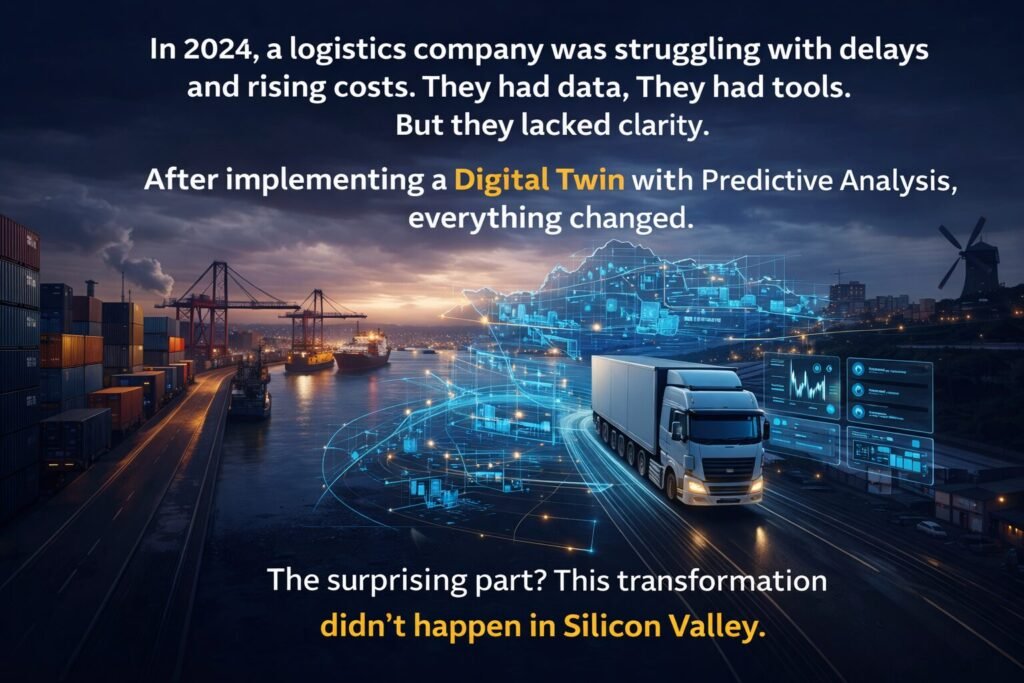
That’s not the future. That’s the power of a Digital Twin, and it’s already transforming how enterprises operate. In early 2024, a senior operations leader at a European logistics firm faced a critical challenge. Delays were rising, costs were becoming unpredictable, and every decision felt reactive. Despite having massive amounts of data, the organization lacked one thing that truly mattered: clarity. The breakthrough came when they implemented a Digital Twin of their operations. Within months, they shifted from reacting to problems to predicting outcomes using Predictive Analysis.
But here’s what most people don’t realize. This transformation didn’t happen in Silicon Valley or a global tech hub. It happened in the Netherlands, a country that is rapidly emerging as the epicenter of Digital Twin innovation in Europe.
And as we approach 2026, one thing is becoming clear, the Netherlands is not just adopting Digital Twin technology, it is quietly becoming Europe’s Digital Twin capital.
The Silent Shift: Why the Netherlands Is Leading the Digital Twin Wave
While many places in the world are trying to find their footing in the world of emerging technologies, the Netherlands has taken a more structured and execution-oriented approach. They are creating a connected ecosystem, powered by Digital Twin technology. In logistics, manufacturing, and infrastructure, Digital Twin solutions are being integrated into core operations. This is not a shift driven by hype, but by success and long-term strategy.
In short, by 2026, the Netherlands is poised to be the Digital Twin capital of Europe. Not because of visibility, but execution.
Case Studies: Real-World Digital Twin Impact
The following case studies demonstrate how digital twins are already driving real transformation across industries. These are not experimental ideas or future concepts; they are fully deployed systems creating tangible value. Companies are leveraging them to solve critical challenges, enhance operational visibility, and make smarter, faster decisions at scale.
Case Study #1: From Reactive to Predictive in Logistics
One of the prominent supply chain organizations, through Rotterdam, developed a Digital Twin for their logistics network. Earlier, this organization was a reactive decision-maker. They used to act on issues when they arose. By incorporating Predictive Analysis, this organization was able to simulate different scenarios, including delays in ports, route delays, and demand fluctuations. This allowed the organization to anticipate issues and act accordingly.
Results:
- 28% reduction in delays
- 19% cost optimization
- Enhanced decision-making
This was a major shift from analyzing past events to anticipating future events.
Case Study #2 - Smart Manufacturing at Scale
The second case study is about a mid-sized manufacturing organization in the Netherlands. This organization used Digital Twin to enhance efficiency in production and minimize downtime. In the past, this organization used reactive decision-making. They would respond to issues when they occurred. By incorporating Predictive Analysis, this organization was able to anticipate potential machine failures and schedule maintenance accordingly.
Impact:
- 32% reduction in downtime
- 21% increase in efficiency
This is a good case study on how smart manufacturing, powered by Digital Twin, can bring about significant business outcomes.
The Ecosystem Advantage: Why This Growth Is Unique
One of the biggest reasons that this growth is happening at such a high rate in the Netherlands is that this is a unique ecosystem. While other nations may be more focused on getting technology implemented, this ecosystem is more focused on how different organizations and government bodies can collaborate and cooperate. Some of the biggest factors that are causing this growth are:
- The integration of AI and data infrastructure
- The innovation initiatives that are being taken by the government
- The high number of enterprise decision-makers
- The high rate of inter-industry collaboration
The most important factor is that this is an ecosystem that is all about implementation and not just exploration.
The Role of Digital Twin Summit Netherlands
One of the biggest factors that is driving this ecosystem is the Digital Twin Summit Netherlands. The biggest difference between the Digital Twin Summit and any other conference is that this is a conference that is all about gaining insights and using that knowledge. It is a conference that allows different enterprises to come and understand how they can leverage this technology and benefit from it by using Predictive Analysis.
What Many Companies Are Missing Out On
While many organizations in the European region are still in the process of exploring the Digital Twin technology and its potential in transforming the enterprise, the same is not true in the Netherlands. Organizations in the Netherlands are not only implementing the Digital Twin but also leveraging the power of Predictive Analysis in transforming the enterprise and generating significant ROI. This is the major difference between the early adopters and the rest of the organizations in the European region.
What’s Next
As the year progresses and comes closer to 2026, the adoption of the Digital Twin is likely to grow further in the coming years. Organizations that leverage the power of the Digital Twin and Predictive Analysis would be able to get a significant edge over their competitors in the market. The Netherlands is not only embracing the Digital Twin but is also setting a benchmark for other nations in the region.
Final Insight: This Is Just the Beginning
The emergence of the Digital Twin is not only a technological shift but is also a major change in the way enterprises are run and the way they can leverage the power of the Digital Twin in transforming the enterprise and generating significant ROI.
FAQ's
A Digital Twin is not just a static simulation model. It is a dynamic model in real-time, constantly updating itself with real-time data. This enables businesses to shift from past performance analysis to predicting future performance through Predictive Analysis. In this way, it is much more powerful than other models.
The Netherlands is ahead in Europe in embracing and implementing Digital Twin technology because it has an advanced AI and data infrastructure. The country has an innovative and collaborative framework. In contrast, many other regions in Europe are still in the experimental stages. The enterprises in the Netherlands have already implemented Digital Twin technology in logistics, manufacturing, and smart cities.
Predictive Analysis makes Digital Twin an intelligent decision-making tool. It allows organizations to predict failures in systems and take decisions in advance, thus making decisions faster and more accurately.
Industries such as logistics, smart manufacturing, healthcare, and smart cities can gain maximum from Digital Twin technology. These industries need real-time data for decision-making. They have complex systems, making them suitable for simulation.
No, it is not just for big enterprises. Though big enterprises were the first to adopt this technology, mid-sized enterprises can also take advantage of it. The advancement in AI and cloud computing has now made it easier for them to implement it.
Organizations that don't invest in Digital Twin and Predictive Analysis may end up lagging behind their competitors who are already leveraging the two technologies to optimize their business processes and cut down on operational costs through predictive decision-making.
The Digital Twin Summit Netherlands serves as a major platform where enterprise leaders, innovators, and experts discuss and share real-life case studies, forge new partnerships, and explore the possibilities of Digital Twin and Predictive Analysis in achieving business outcomes.
Yes, the Digital Twin technology has become a vital component of the overall digital transformation strategy in the modern business world. It allows organizations to develop new business models that are not only predictive and scalable but also data-driven.
The future of the Digital Twin technology beyond 2026 is in the development of a new technology that will integrate AI, IoT, and autonomous technology with the Digital Twin technology and Predictive Analysis, thereby allowing the development of intelligent enterprise ecosystems.
A Digital Twin refers to a virtual replica of a physical entity that uses real-time data and Predictive Analysis to simulate the behavior of the entity.
The Digital Twin technology is important in 2026 since it allows organizations to make predictive decisions, minimize operational risks, and accelerate the overall digital transformation process in the enterprise world.