Smart Railways in Europe: How Deutsche Bahn Uses Digital Twin to Optimize Operations
 by
by 
Railway delays don’t begin when trains stop; they begin much earlier, hidden in unnoticed signals, stressed infrastructure, and silent failures building over time. Traditional railway operations are designed to respond after a disruption occurs, which means that by the time action is taken, delays have already cascaded across the network. This reactive model is no longer sustainable in a world driven by speed, precision, and real-time decision-making.
This is where a Digital Twin redefines the entire system. At Deutsche Bahn, a Digital Twin creates a living, real-time digital replica of railway operations, integrating tracks, trains, signals, and infrastructure into one intelligent ecosystem. Every movement, every signal, and every potential risk is mirrored and analyzed continuously. But this isn’t just visibility, it’s foresight.
Powered by advanced Predictive Analysis, the system identifies patterns that humans simply cannot detect at scale. It spots early warning signs, predicts equipment failures, and highlights operational risks long before they escalate into disruptions. Instead of reacting to delays, the system prevents them from happening in the first place. This is the true shift of Industry 4.0, from hindsight to foresight, from control to intelligence. Decisions are no longer based on assumptions or past data alone; they are driven by real-time insights and predictive intelligence that continuously learn and adapt.
The impact is transformational: faster response times, optimized scheduling, reduced downtime, and a dramatically improved passenger experience. Railway operations evolve from being reactive and fragmented to proactive and seamlessly connected.
This isn’t just about improving efficiency; it’s about redefining how railways operate at their core.
From chasing delays…
to stay ahead of them.
From Reactive Railways to Predictive Systems
Traditional railway systems don’t fail suddenly, they fail silently, long before delays become visible. And by the time operators react, the disruption has already spread across the network. This is exactly where a Digital Twin transforms the game.
At Deutsche Bahn, a Digital Twin creates a real-time, data-driven replica of the entire railway ecosystem, tracks, trains, signals, and infrastructure all continuously connected through advanced systems. Powered by Predictive Analysis, this intelligent model doesn’t just monitor operations; it anticipates them. It detects weak signals, identifies hidden risks, and forecasts potential failures before they turn into costly delays.
This is the core of Industry 4.0, where infrastructure evolves from reactive to predictive. Decisions are no longer based on past incidents but on real-time insights and future probabilities.
The result? Faster interventions, smarter scheduling, and a railway system that thinks ahead instead of catching up.
This is not just innovation, it’s a complete operational shift.
From reacting to disruptions…
to eliminate them before they even begin.
How Digital Twin Optimizes Railway Operations
With a Digital Twin, Deutsche Bahn can simulate multiple real-world scenarios instantly:
- What happens if a train is delayed?
- Where will congestion build next?
- Which assets are at risk of failure?
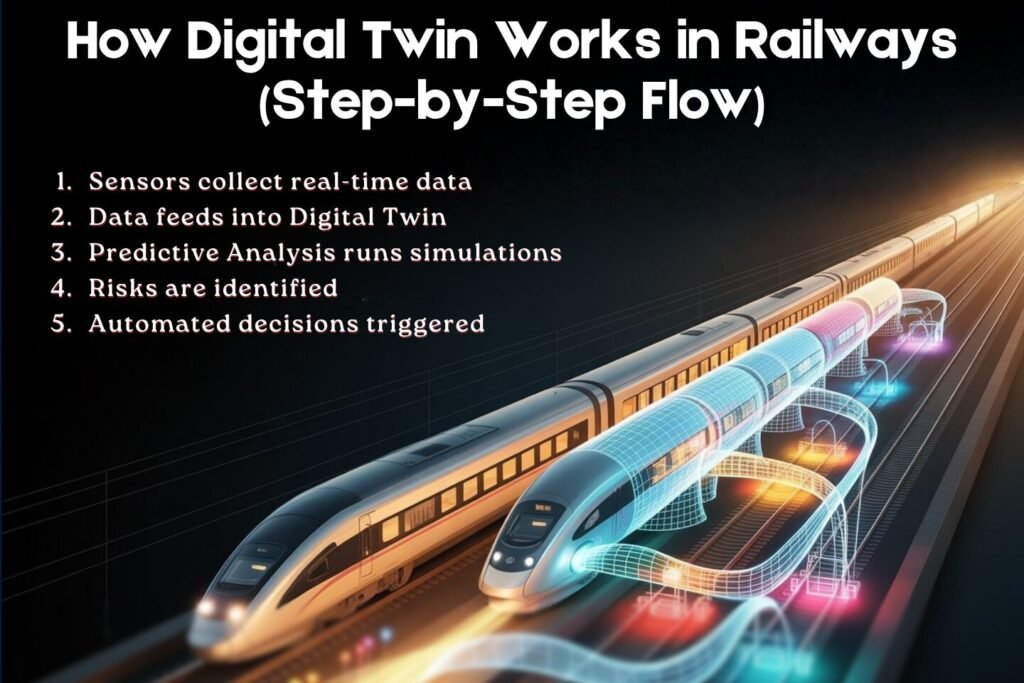
Using Predictive Analysis, decisions are no longer based on assumptions, they are backed by real-time intelligence. This allows:
- Faster response times
- Smarter scheduling
- Reduced operational disruptions
- Improved passenger experience
This is why Digital Twin is becoming essential to Industry 4.0 infrastructure.
Predictive Analysis: The Intelligence Layer
At the core of every Digital Twin is Predictive Analysis. Deutsche Bahn uses Predictive Analysis to:
- Detect early signs of failure
- Optimize maintenance schedules
- Improve energy and asset efficiency
Instead of waiting for breakdowns, the system predicts them. At the Digital Twin Summit Netherlands, this capability is now seen as the defining advantage of Digital Twin adoption.
Why Europe Is Leading in Digital Twin Railways
Europe’s railway networks are complex, high-density, and interconnected. This makes Digital Twin adoption not optional, but necessary. By integrating Digital Twin into Industry 4.0, Deutsche Bahn is:
- Increasing reliability
- Enhancing real-time visibility
- Improving long-term planning
This is what modern infrastructure looks like when powered by Predictive Analysis.
Conclusion
For decades, railways were built to respond. Now, they’re being rebuilt to predict. A Digital Twin doesn’t just show what’s happening, it reveals what’s about to happen next. With continuous Predictive Analysis, Deutsche Bahn is turning uncertainty into foresight and disruption into decisions made before failure begins.
This is the real shift in Industry 4.0:
From reacting to problems, to eliminating them before they exist. That’s why at the Digital Twin Summit Netherlands, the question has changed:
Not “Do we need a Digital Twin?”
But:
“How long can we afford to operate without one?”
Because once systems start predicting reality…
Guesswork disappears, and so do preventable delays.
FAQ's
Deutsche Bahn's implementation of Digital Twin technology allows for the creation of a real-time virtual representation of their entire rail network (including trains, tracks, and signalling systems). This digital replica uses live data to dynamically model, using Predictive Analysis to create possible scenarios, so that operational decisions can be made quickly, intelligently and with confidence before any disruption occurs.
Predictive Analysis in rail systems refers to the application of advanced data modelling and algorithms to find and define trending patterns, forecast potential failures, and optimise scheduling. In a Digital Twin environment, it allows for the transformation of raw data into actionable information for railway operators; this enables operators to avoid failures rather than react to them.
In the current era of Industry 4.0, Digital Twin technology provides the foundation for Transformation by producing real-time visibility of the system, predictive intelligence and automated decision-making capabilities. This means that the rail network will be able to operate in a more efficient manner and connect with real-time data and feedback in order to be responsive to continuously changing conditions.
Digital Twin enhances the rail operating environment by continuously monitoring real-time train operations and utilising Predictive Analysis to identify early signs of disruption. By providing operators with actionable information, they are able to take action prior to disruptions occurring, which will benefit both passenger service and national rail performance.
The Digital Twin Summit Netherlands is focusing on the real world application of Digital Twin technologies through Predictive Analysis, the transformation of Industry 4.0, and how organizations use data-driven systems to increase efficiency and the ability to make better decision making
Yes. Digital Twin technology greatly improves railway efficiency in a few ways. It allows for improved scheduling of trains, predicting maintenance needs and better utilization of assets. By providing a connected view of the rail network, Digital Twin technology allows for more efficient operations and resource management.
There are several types of technology that enable Digital Twin systems to be created for railways, including, but not limited to: the Internet of Things (IoT) sensors; Artificial Intelligence (AI); Cloud Computing; and Predictive Analysis. These types of technologies work together to create an interconnected environment where real-time data is available to help make intelligent decisions.
Digital Twin technology is very scalable and can be designed to support large, complex railway networks. Digital Twin technology can integrate multiple systems and data sources to support expanding railway networks and high-density operations.
Predictive Analysis helps railways maintain their assets by provide an early indication of wear, stress or failure of that asset. Predictive Analysis helps maintenance teams to take action earlier, thus, reducing the amount of time an asset is down, preventing breakdowns and, in essence, increasing the useful life of the asset.