Why 80% of Manufacturers Will Adopt Digital Twins Before 2030, And What Industry Leaders Must Do Now
 by
by 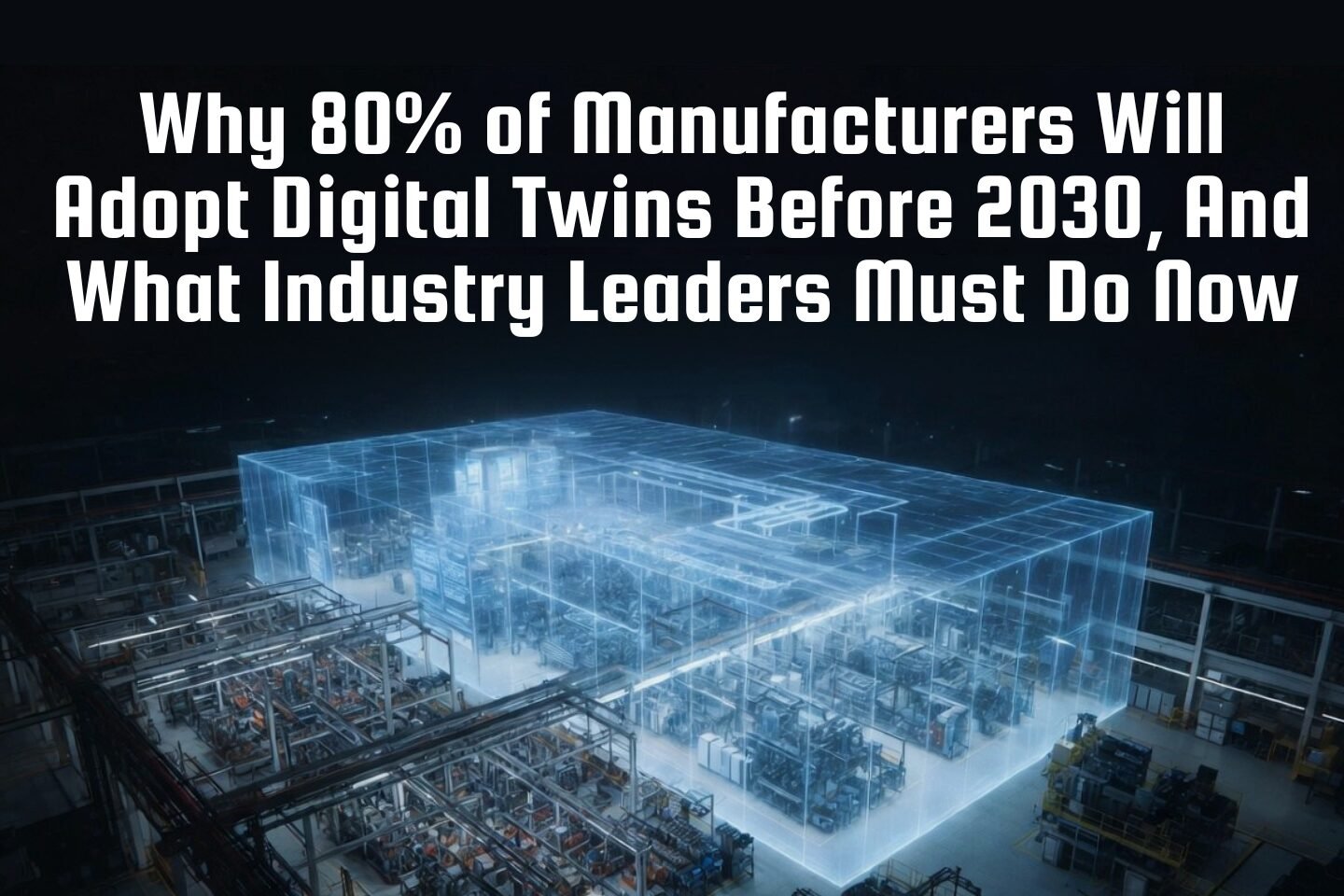
Right now, somewhere in the world, a manufacturer is testing an entire production line without touching a single machine.
They are predicting equipment failures before breakdowns happen. Optimizing operations before investing millions. And making strategic decisions using simulations instead of assumptions.
Meanwhile, many manufacturers are still relying on reports, historical data, and reactive decision-making.
This growing gap is creating a new industrial divide. On one side are companies using Digital Twin technology to simulate the future before acting. On the other are organizations discovering problems only after production stops. Industry experts now predict that nearly 80% of manufacturers will adopt Digital Twin systems before 2030, not as innovation projects, but as survival infrastructure.
Because in modern manufacturing, the biggest risk is no longer machinery failure. It’s making decisions without seeing what happens next. And that is exactly why Digital Twin adoption is accelerating faster than any industrial technology in recent history.
What Is Driving Massive Digital Twin Adoption?
A Digital Twin is a virtual replica of a physical asset, system, or process that is continuously updated using real-time operational data. A Digital Twin is not a static technology; it is dynamic, meaning a Digital Twin allows a business entity to test outcomes before making real-world changes to a business process.
This is a game-changer for decision-making within a business entity. Companies can now predict, simulate, and optimise the outcome before the risk even happens. Some of the key factors that are driving the adoption of Predictive Analytics include:
- Increasing complexity in operations
- Increasing demand for real-time visibility
- Optimizing costs
- Initiatives in smart manufacturing
- Industry 4.0 transformation
As the world moves towards intelligent factories, Digital Twin technology is the brain behind the operation in the manufacturing industry.
How Predictive Analytics Is Powering the Digital Twin Revolution
At the core of every successful Digital Twin is the presence of Predictive Analytics. Predictive Analytics allows organizations to study historical machine data, as well as real-time machine data, in order to predict the equipment, production, or maintenance.
Instead of asking, “What went wrong?”
Manufacturers now want to know, “What will happen next?”
Using the Predictive Analytics capabilities in the Digital Twin platform, organizations can now:
- Prevent machine downtime before failures
- Optimize production
- Optimize the supply chain
- Optimize asset lifecycle management
- Optimize the accuracy of the overall decision-making process
Thus, the reason why Digital Twin is gaining popularity is the shift in the operational capabilities of the overall industry.
The Competitive Advantage: Faster Decision-Making at Scale
The competitiveness of modern manufacturing depends on the speed of decision-making. Operational changes need to be evaluated instantly rather than weeks later through reports.
Digital Twin environments enable business executives to test business decisions virtually before implementation. For example:
- Operate production capacity virtually
- Test supply chain disruptions virtually
- Investment risks can be tested virtually
Organizations that implement Digital Twin technology report faster and more confident decision-making compared to other manufacturers. This impacts profitability and resilience positively.
What Happens to Manufacturers That Delay Adoption?
There is a clear pattern when analyzing the history of technology and industry developments. Manufacturers that delay implementing new and impactful technology, such as Digital Twin technology, experience a decline in competitiveness in the future.
If Digital Twin technology is not implemented, manufacturers can expect:
- Maintenance costs are increasing
- Innovation cycles are declining
- Operational risks are increasing
- Strategic decision-making to be reactive
Meanwhile, manufacturers that implement Predictive Analytics and Digital Twin technology continue to optimize and innovate. By 2030, Digital Twin technology will be the dividing line between industry leaders and laggards.

Why Industry Leaders Are Discussing This Shift at the Digital Twin Summit Netherlands
As Digital Twin technology implementation increases globally, industry leaders, engineers, and innovation experts from all over the globe are attending the Digital Twin Summit Netherlands to discuss and share real-world implementation strategies for Digital Twin technology and Predictive Analytics.
The Digital Twin Summit Netherlands is an essential event where industry leaders and executives in manufacturing discuss and debate the impact of Digital Twin technology and Predictive Analytics on enterprise decision-making.
The topics discussed at the Digital Twin Summit Netherlands include:
- Scaling Smart Manufacturing ecosystems
- Using Predictive Analytics in production
- Using Digital Twin technology
- Future industrial strategies
For manufacturers looking to implement changes in the future, industry events such as the Digital Twin Summit Netherlands provide invaluable information that cannot be gathered through reports.
Final Takeaway: The Road to 2030 Has Already Started
Digital Twin technology is no longer considered an experimental technology for innovation and growth.
It is becoming the foundation of intelligent manufacturing.
Organizations that implement Digital Twin technology solutions today gain:
- Operational resilience
- Predictive intelligence
- Faster decision-making
- Sustainable growth advantage
By 2030, Digital Twin technology will not be the difference between innovators; it will be the difference between survivors.
FAQ's
Digital Twin, in the manufacturing industry, is a virtual representation of a machine, process, or system, which is usually simulated to help a company make decisions before implementing a system. The significance of a Digital Twin is that a manufacturing company is able to improve its operational efficiency, reduce potential risks, and improve its decision-making process by applying Digital Twin technology.
Manufacturers are increasingly adopting Digital Twin technology to help prevent machine failures, enhance production efficiency, and reduce operational costs for a company, as well as to stay competitive in a dynamic business world.
Predictive Analytics is a tool that provides a simulation of a machine's behavior, which is usually analyzed within a Digital Twin system to help a manufacturing company improve its operational efficiency and decision-making process.
Digital Twin provides a simulation of a machine, process, or system, which is usually analyzed to help a company improve its business decisions, as well as to help a company understand its operational efficiency.
Some of the industries that will benefit from Digital Twin technology include automotive manufacturing, aerospace engineering, energy production, infrastructure development, healthcare systems, and Industry 4.0 manufacturing environments.
Yes. Digital Twin technology is considered a fundamental pillar of Industry 4.0, as it connects the real-world operations of manufacturing with the power of the digital world, thereby creating automation, prediction, and real-time optimization of the manufacturing process.
With the help of Digital Twin technology, manufacturers can solve problems like unexpected downtime, inefficient production planning, costly maintenance, supply chain issues, and inefficient decision-making processes.
The Digital Twin Summit Netherlands is a conference that brings together industry leaders, engineers, and innovation experts from all over the world to share their experiences with Digital Twin, prediction, and future manufacturing decision-making frameworks.
Yes. With the help of the latest cloud technologies, small and mid-sized manufacturers can now benefit from Digital Twin technologies, which will help them increase their operational efficiencies.