Digital Twin
Turning Data Into Real-World Decisions
The Complete, Practical Guide for Businesses
Most digital systems still rely on assumptions. Digital twins don’t.
Today’s leading organizations are no longer testing ideas, products, or decisions after they’re built, they’re simulating outcomes before anything exists. This shift is quietly redefining how industries design, predict, and operate. This guide breaks down how digital twin technology works, why it matters now, and how it’s becoming a foundation for smarter, faster decision-making.
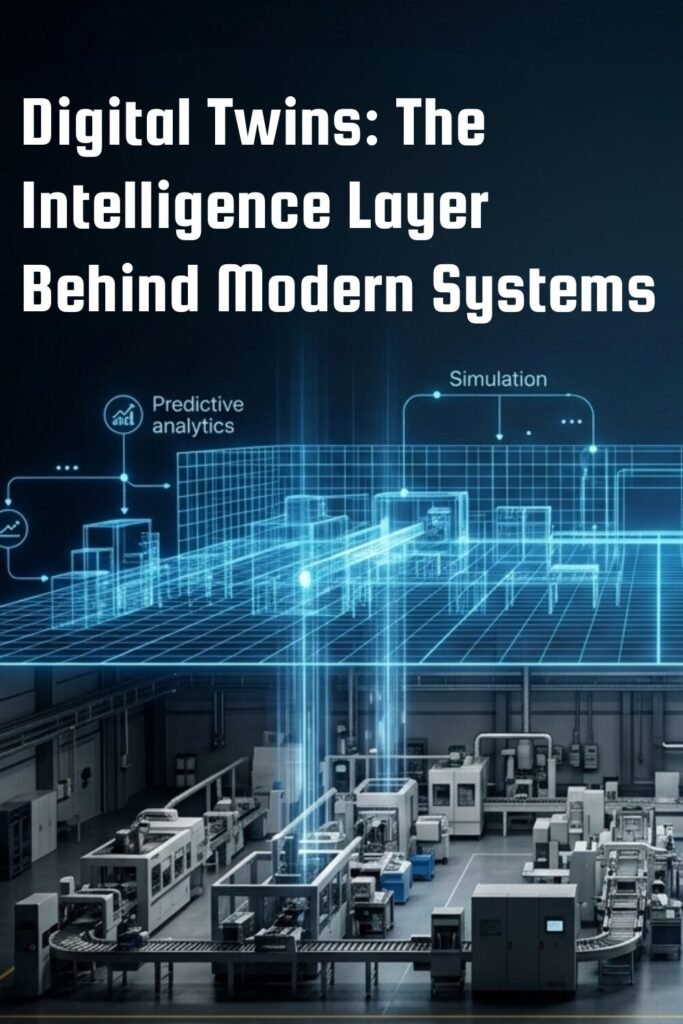
A Digital Twin is not just a 3D model, and it is not just a simulation.
Digital Twin is a real-time digital image of a real-life physical asset, system or process, with active data links between the digital image and its real-world counterpart. What separates Digital Twin from other technologies is its intelligence, to understand the current behaviour of an asset, simulate potential behaviour and assist with real-time decision making regarding the physical asset. Digital Twin enables:
- Always connected to real-time data sources
- Learning from historical and current real-time data connections.
- An ability to simulate “what-if” scenarios.
- Tailored to potentially impact your choices with actual operations in real-time.
This is why Digital Twin is often referred to as “Decision Engines”, not “Visualisation Tools”. This comprehensive guide will help you understand the evolving role of Digital Twins in modern enterprises, including insights commonly discussed at leading industry forums such as the Digital Twin Summit. The real power of digital twins isn’t visualization, it’s foresight.
Organizations using digital twins aren’t reacting faster.
They’re deciding fast.
Why Digital Twins Matter Today (And Why They Didn’t 10 Years Ago)
1
Systems Have Become Too Complex
Today’s supply chain, factory, city, and energy infrastructure are no longer linear. They have become complex networks with thousands of variables. The human mind and static dashboards cannot handle this complexity.
2
Real-Time Data Is Now Abundant
The data from the IoT sensors, connected machines, APIs, and cloud platforms is now available as continuous streams of data. However, the use of Digital Twins would ensure that the data from these streams is utilized to the fullest extent.
3
AI Made Prediction Practical
Machine learning and advanced analytics help Digital Twins evolve from “monitoring” activities into predictive, optimize, and autonomous decision support. The meeting point of these three factors has been the reason why the concept of Digital Twins moved from being researched at laboratories to being implemented on the ground.
What Makes a True Digital Twin (And Why Most Are Fake)
There are many offerings for the concept of a “Digital Twin.” Most are not. A Digital Twin has to satisfy the following conditions to be considered a true Digital Twin, a distinction often emphasised by experts speaking at the Digital Twin Summit. A Digital Twin has to satisfy the following conditions to be considered a true Digital Twin:
- Continuous Real-Time Synchronization
The twin has to update constantly in relation to the physical system. Batch updates, manual updates, and late updates violate the “twin” relationship. - Bi-Directional
A Digital Twin not only takes in data, but it also drives decisions and actions. The impact of changes tested on the twin affects actual operations. - Predictive Capability
A Digital Twin has the ability to do predictive analysis, allowing organisations to predict future outcomes rather than reacting to past events. It can help answer critical questions like
What would happen if the demand for the product goes up?
Which part will break next?
Which option is best in terms of cost and risk?
By simulating scenarios in advance, Digital Twins support smarter, data-driven decision-making. - Scenario Simulation
The simulation capability to test for several outcomes before making a decision is a key part of the process. If simulation does not exist, then the system would be descriptive, not intelligent. - Lifecycle Awareness
A Digital Twin understands the system’s past behaviour, present state, and future course over its entire life cycle. If any of these elements are absent, it is not considered a Digital Twin; the system is better described as monitoring, analytics, or visualisation instead.
Digital Twin vs Simulation vs Dashboards
Dashboards
Dashboards are retrospective. They display what has already happened. They work well as a reporting tool. However, they do not work as a decision-making tool in a dynamic setting.
Simulations
Simulation models a hypothetical situation, but they are usually static and are disconnected from real-time activities. They can help predict future outcomes, but they do not reflect what is happening now.
Digital Twin
A Digital Twin combines real-time data streams with continuous simulation models, enabling predictive intelligence and providing actionable decision support to optimise performance, efficiency, and strategic planning.
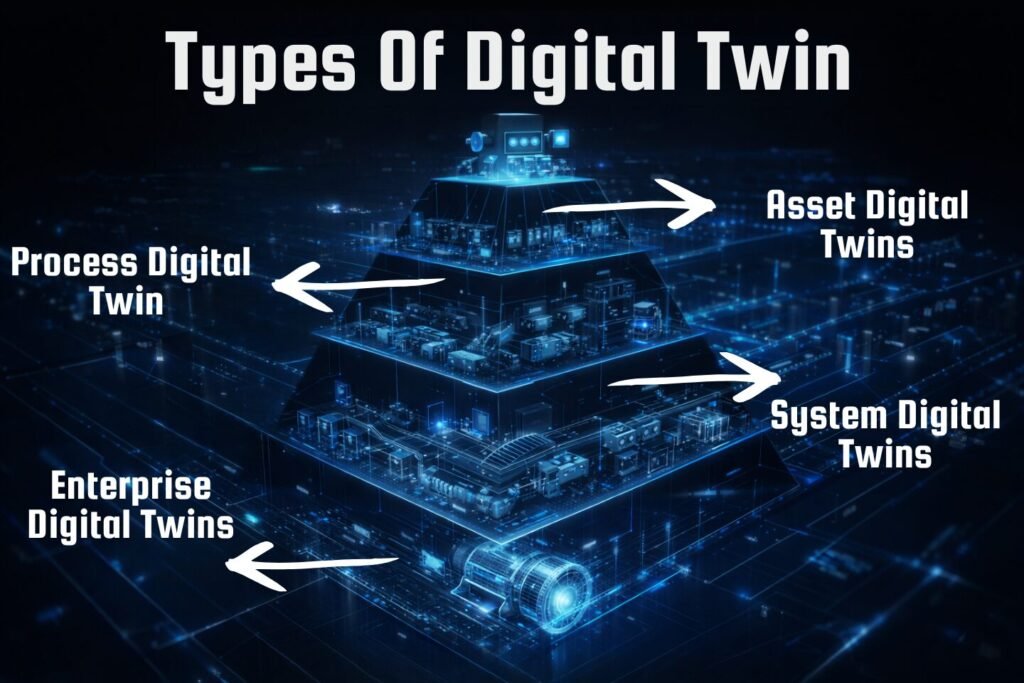
Types of Digital Twins (With Real Context)
- Asset Digital Twins
An Asset Digital Twin focuses on individual machines, vehicles, or equipment. Often found in the manufacturing and energy industry - Process Digital Twin
Process Digital Twin model workflows like production lines, logistics chains, or clinical paths. - System Digital Twins
System Digital Twins represent entire interconnected systems like supply chains, smart cities, or power grids. - Enterprise Digital Twins
Integrate various systems, processes, and assets to enable enterprise-wide decisions. Most modern organizations tend to progress through this hierarchy.
This progression mirrors the Digital Twin maturity frameworks commonly referenced at the Digital Twin Summit.
Digital Twin Use Cases (Expanded by Industry)
Manufacturing
Digital twins allow manufacturers to predict the failure of machines, optimise production planning, minimize downtime, and optimise quality control. Manufacturers can now prevent problems from happening, rather than reacting to them
Supply Chain
In supply chains, Digital Twins give real-time visibility into suppliers, transportation, inventory, and demand. They enable businesses to model disruptions, redirect shipments, and manage inventory.
Construction
Digital Twins enable the identification of design conflicts, simulate construction schedules, avoid cost overruns, and enhance safety. They link design intent to real-world conditions.
Energy & Utilities
The Digital Twins are used by the utilities in the management for grid stability, demand forecasting, tracking the degradation of assets, and the distribution of electricity.
Healthcare
Digital twins enable patient-specific modeling, equipment usage, and hospital workflow optimization, resulting in better patient outcomes at lower costs.
Smart Cities
Digital Twins at the city level are used to model traffic, infrastructure usage, emergency response, and the environment impact to support better urban planning.
How Digital Twins Enable Predictive Decision-Making
The traditional enterprise system was never intended for anticipation. They were built to record, report and react. Dashboards, reports, and analytics tools typically answer only one fundamental question: What already happened? While this retrospective insight has value, it is very dangerous in an environment where complexity, speed, and uncertainty drive operations on a daily basis.
The Digital Twins have revolutionised this dynamic.
Rather than giving you a rearview mirror, the Digital Twin offers you a forward-looking lens, an idea central to the predictive decision-making philosophy shared across keynote sessions at the digital twin summit. They ingest data in real-time from assets, processes, and systems in the physical world, so you can see what is happening in the moment—not in hours or days—but also more importantly, so you can see what is going to happen next under different conditions and decisions.
This makes it possible for decision-makers to go beyond observation, as they can ask questions like:
- What is happening throughout the system now?
- What will be the most probable state if nothing changes?
- How will the outcome differ if we intervene today versus tomorrow?
- Which decision offers the best performance while minimising risk?
This transition from hindsight to foresight facilitates the emergence of this new operational style. There is the opportunity to step in before the problem develops into a failure. Problems are detected for prevention before they become unmanageable threats. Decisions are made more quickly because they are informed by the prediction of outcomes rather than mere human intuition. Most importantly, though, improved performance in an uncertain environment is achieved.
The objective of predictive decision-making is not to achieve perfect foresight. Rather, it is to minimise uncertainties, maximise confidence, and make decisions that work well in various possible situations. Therefore, the role of Digital Twins is to convert the nature of decision-making from reactive problem-solving to proactive system management.
Digital Twin Architecture: An End-to-End View
A strong Digital Twin is built on a layered architecture designed to support accuracy, speed, and scale. The base layer includes the physical assets and/or processes, machines, infrastructure, logistics networks, or workflows that provide the real-world signals.
Such Signals are extracted by sensors, IoT sensors, and other interconnected systems, which are fed into ingestion and streaming pipelines. This layer has to process a high volume of data reliably and with low-latency. The data is processed and aggregated across systems to present a unified and trustworthy representation of the operations of the organization.
Above this foundation sits the system modelling layer, which encodes how assets and processes interact. This is where business logic, constraints, and relationships are specified. AI and analytics engines run on top of these models, generating predictions, finding anomalies, and areas of optimization.
Simulation and scenario tools enable teams to examine different possible futures by trying decisions in the virtual space before applying them to the physical space. Finally, decision interfaces such as dashboards, APIs, and voice interfaces make insights actionable by both humans and machines. Each level of this architecture needs to be developed with performance, reliability, and scalability considerations.
Why Digital Twin Projects Fail and How to Avoid It
However, the potential of Digital Twins is still unmet in many cases. Among the most prevalent reasons for this is the fact that the application of Digital Twins is considered only an IT project or an achievement of cool graphics.
Another common problem that arises is a lack of data readiness. Unintegrated data, unconnected systems, and ambiguous ownership impact the credibility of the twin. Additionally, resistance to change within an organization is also a contributing factor because predictive systems call for changes to workflows, responsibilities, and decision-making.
On the one hand, there are unrealistic expectations. Digital Twins are not silver bullets that give instant returns on investment. They take time to develop and evolve as models become more sophisticated and people become more skilled at working with them. The key to successful implementations is decision ownership. This means that the top companies specify, from the outset, what decisions the Digital Twin can support, as well as who makes those decisions based on the Digital Twin’s results. This means that technology strategy drives technology choice, not the reverse.
What Leading Organizations Do Differently
The organizations that achieve success by using Digital Twins adopt a fundamentally different mindset. They tend to concentrate on modelling complete systems instead of focusing on isolated assets, recognising that value emerges from understanding interactions and dependencies
The Digital Twin is fully integrated within the daily operations, not confined to innovation labs or pilot projects. The twin is treated as a living entity, not a finished product, as the models are constantly updated based on new information.
Business Value and Return on Investment
In today’s competitive marketplace, as the technology of the Digital Twin continues to evolve, its effects are able to be measured. This has the effect of minimising downtime, where failures are forecasted instead of being tolerated. There are also lower operational expenditures due to optimised resource utilisation.
The outcomes for customers are also positive. Improved operations mean that service levels are increased, and trust is built. The return on investment grows exponentially with time because the Digital Twin evolves in complexity. These long-term value dynamics are consistently reinforced through enterprise success stories at the Digital Twin Summit.
Security, Governance, and Trust
Since Digital Twins have a direct impact on decisions, trust becomes the priority. Secure Data pipelines, access control, explainability, and traceability are very important. Governance helps to ensure that insights are trustworthy, traceable, and compliant with regulations, topics gaining increasing prominence in governance-focused panels at the Digital Twin Summit.
Without these, Digital Twins could become a liability rather than an asset.
The Future of Digital Twins
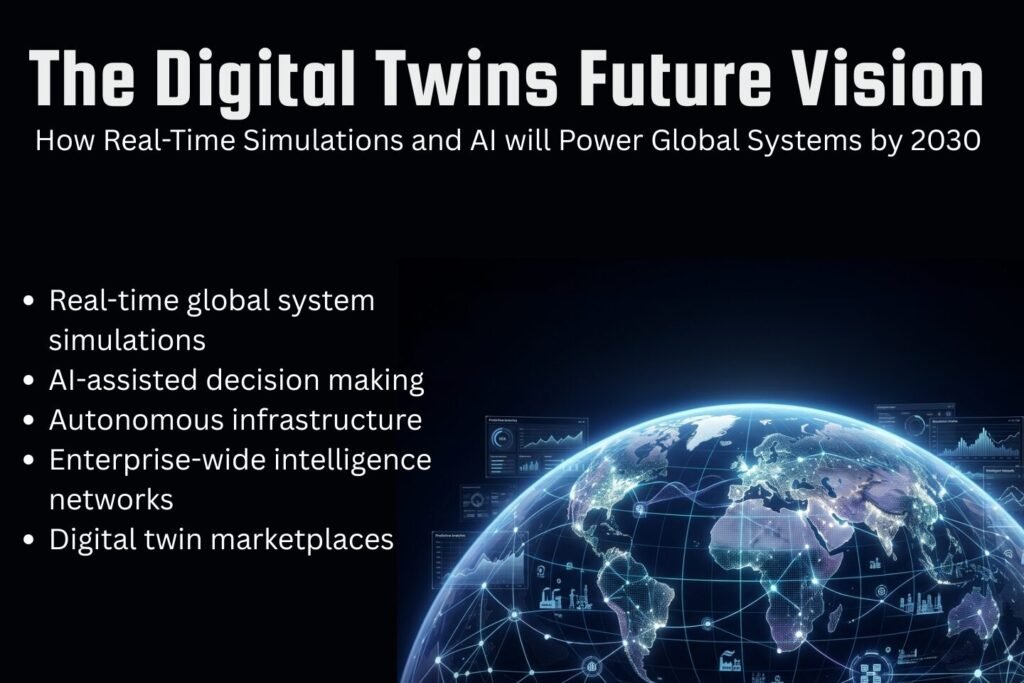
The next phase of the Digital Twin will introduce autonomous decision-making capabilities, agent models, and cross-enterprise twins that operate across organization boundaries, future-facing capabilities that define the roadmap discussions at the Digital Twin Summit. Natural language interfaces will become the standard, and self-improving models will continuously improve themselves based on the outcomes.
With the development of these capabilities, the Digital Twin is going to become the operational layer for complex organizations, shaping decisions well before the point when reality demands a reaction.
The Final Takeaway
Digital twins are not about visualization. They are about understanding systems deeply enough to act with confidence before reality forces your hand. Organizations that master Digital Twins will not just react faster, they will shape outcomes. A strategic insight widely shared by industry leaders speaking at the Digital Twin Summit. Understanding digital twins today isn’t optional. It’s fundamental.
FAQ's
What is a Digital Twin in simple terms?
A Digital Twin is essentially an "accurate real-time digital representation of an object, system, or process that is kept in sync with reality." In other words, it is not merely a dashboard or model that provides information about the current state of something. Rather, it can predict the outcome of future actions that have yet to be implemented in reality.
How is a Digital Twin different from simulation or modeling tools?
Simulation models are static, non-real-time systems. A Digital Twin, by contrast, consumes real-time data, reflects its real-time status, and enables testing against real conditions, as opposed to what-if scenarios. That’s what gives Digital Twins their operational strength.
Why are Digital Twins becoming important now?
Digital Twins have emerged as essential because supply chains, factories, cities, or energy infrastructures, are too complex for humans or dashboards to manage alone. The availability of real-time data, connectivity via IoT, and AI capabilities has made predictive and systemic decision-making possible on a large scale.
What problems do Digital Twins actually solve for businesses?
Digital Twins assist companies in transitioning from a reactive to a proactive approach. They predict failures before they occur, simulate disruptions before they happen, optimize performance under uncertainty, and guide decisions that balance cost, risk, and efficiency, especially in complex, fast-changing environments.
What is the future of Digital Twin technology?
The future of Digital Twins revolves around autonomous decision-making, agent-based models, and cross-enterprise Digital Twins. Digital Twins can be used by everyone with the help of natural language interfaces and self-learning models, making Digital Twins the operational level for managing complex organizations.
How do Digital Twins use AI and machine learning?
The intelligence of the Digital Twins is provided by the use of AI. Machine learning models examine the past and present to identify trends, make predictions about the future, and provide information on possible risks. The optimization algorithms assess various options for decision-making so that the Digital Twin not only provides information but suggests decisions.
What industries benefit the most from Digital Twins?
Sectors which have greater complexity and uncertainties include manufacturing, supply chain, energy, construction, healthcare, smart cities, etc benefit the most from digital twin. In such sectors, Digital Twins are useful as they handle interdependent systems whose small changes may result in huge ripple effects.
Can Digital Twins support real-time decision-making?
Yes. Digital Twins support real-time decision making. By continuously processing real-time data and running parallel simulations, Digital Twins enable decision-makers to view what is occurring, what is likely to occur next, and which action will produce the best results with the lowest risk.
Why do many Digital Twin projects fail?
Digital Twin implementations mostly fail because they are approached as IT projects or visualization tools instead of decision systems. Common problems include poor data integration, decision ownership issues, resistance to change, and misaligned expectations.