Faster, Smarter, Greener: Digital Twins Reshaping the Automotive Industry
 by
by 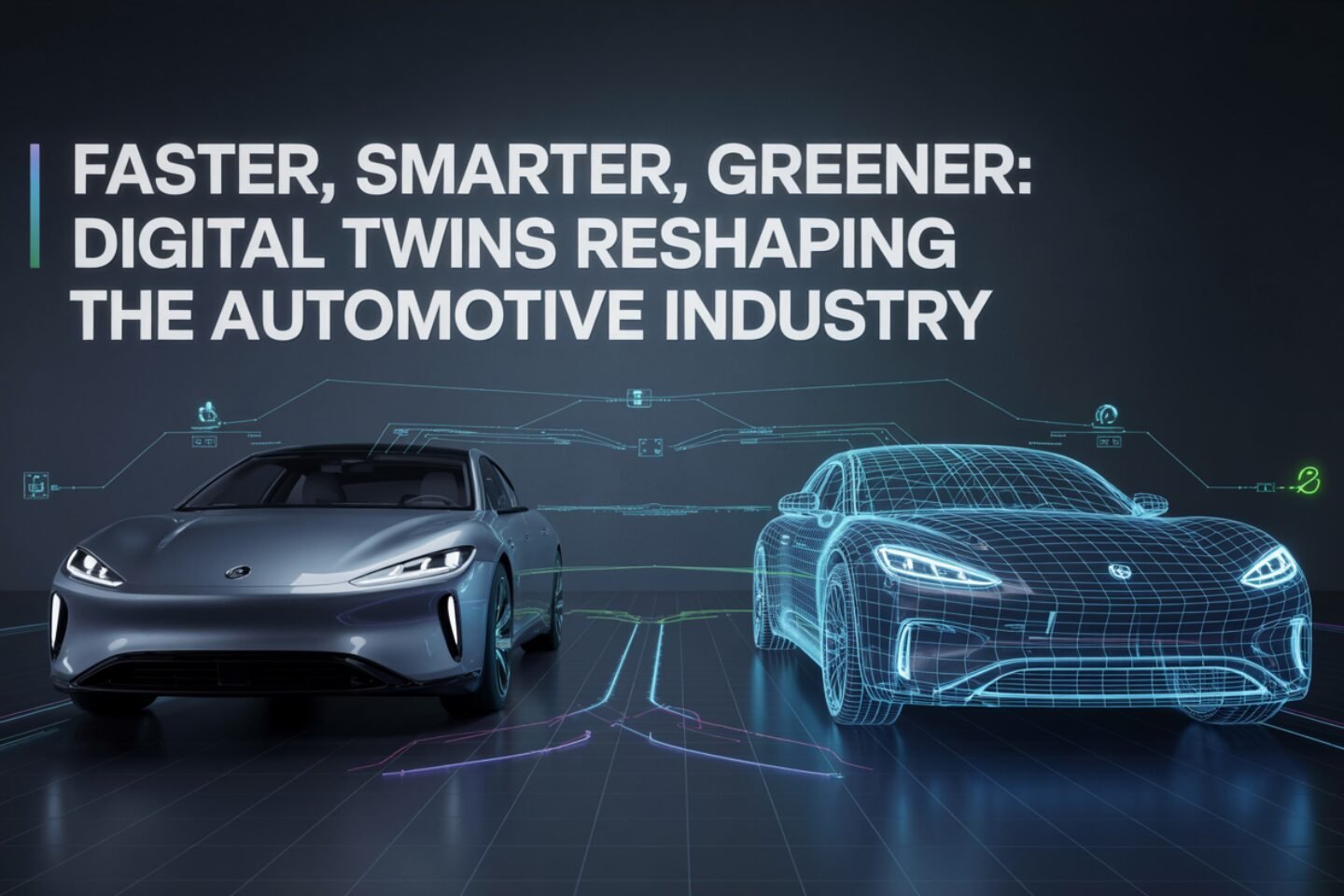
There is an ongoing change happening in the automotive industry today. As customer expectations continually rise and the rate of innovation increases due to global competition and the need to meet sustainability goals, all of this requires a change in the way that cars are designed, tested, and delivered. An automotive manufacturer can no longer continue with traditional methods of development.
Today, however, Digital Twins are changing the way automotive companies approach innovation. Digital Twins have the capability of combining real-time data with advanced simulations and virtual modelling to give companies the knowledge and information they need to design better cars, increase performance, and make better decisions at a much quicker pace, even before the new cars roll off the production line.
Understanding Digital Twins in the Automotive Industry
A Digital Twin is a digital version (or model) of a physical asset, system, or process that is updated continuously through the combination of many different technologies.
In terms of an automotive vehicle, a Digital Twin can include a digital image of the vehicle’s complete physical structure and its operational behaviour; it can even include how the vehicle behaves throughout its lifecycle.
Using Digital Twins allows engineers and other decision-makers the ability to test scenarios, study the results of those scenarios, and improve the design of their vehicles. Automotive companies are able to perform thousands of simulations safely, quickly and at relatively low costs instead of using only real-world testing facilities.
Digital Twin technology allows automotive companies to accelerate their innovation efforts, increase their design accuracy, and significantly reduce their development risks.
Virtual Prototyping: Accelerating Automotive Innovation
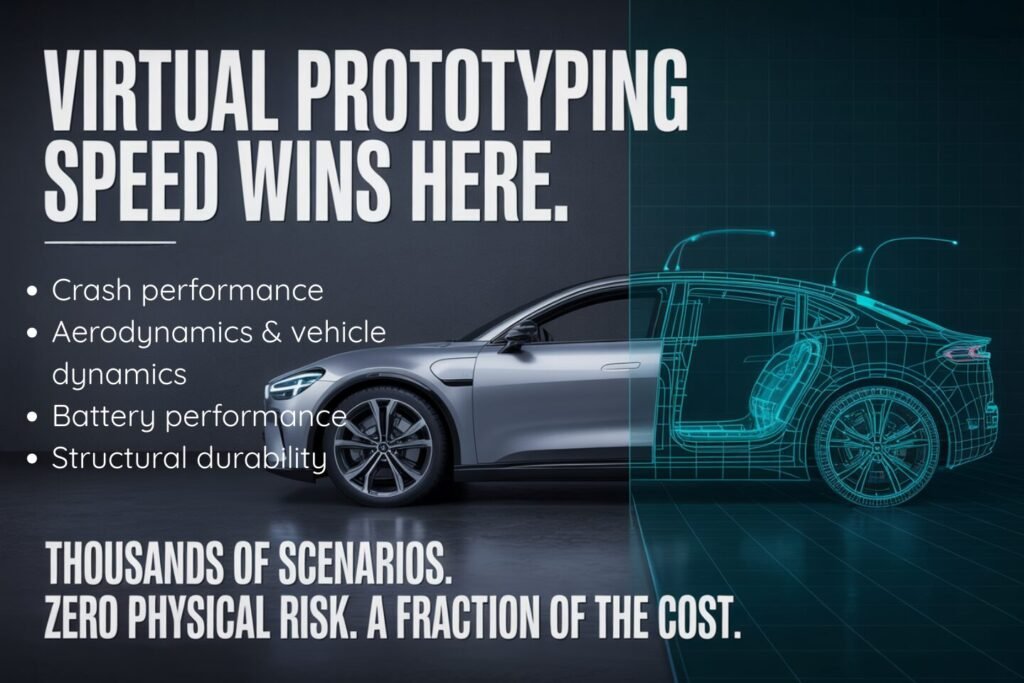
Building and testing physical prototypes used to take months and require a large amount of capital outlay, but the use of digital twins means that manufacturers have a way to create and test virtual prototypes. Car manufacturers can use digital technology to simulate a range of processes, including:
– Crash testing
– Aerodynamics and vehicle dynamics
– Battery performance and thermal behaviour
– Structural durability and wear.
By simultaneously testing various designs using computer models, manufacturers can identify the best possible configuration much earlier in the design and development process, resulting in much quicker product launches and the ability to develop new products with much greater confidence as the automotive sector moves towards the development of electric, connected and autonomous vehicles.
Predictive Intelligence for Vehicle Performance
Digital twins offer much more than just a way to develop products through design. Connected vehicles record and produce onboard sensors over the lifespan of a car, allowing connections to Digital twins to be sent to track actual performance under real-world conditions. By reviewing this information, organisations are digitally able to analyse components’ Health and identify any degradation in performance, maintenance requirements, etc., before issues arise. Consequently, manufacturers and fleet providers can reduce risks associated with safety, reliability, and customer satisfaction for consumers and provide a more reliable ownership experience, whereas for enterprises, this results in reduced operating costs and more intelligent/lifecycle management.
Driving Sustainability Through Digital Twins
Sustainability is a primary focus for the automotive sector; Digital twins support this commitment by allowing automotive companies to model/optimise such metrics as: energy use, efficiency of materials, weight/emissions of vehicles, and overall environmental impact of both vehicles and vehicles’ lifecycle. By analysing sustainability metrics digitally, automotive companies can make informed design decisions that minimise waste and maximise energy efficiency while also adhering to global carbon reduction initiatives—without compromising innovation.
The Road Ahead for Digital Twins in Automotive
As technology, including artificial intelligence (AI), internet of things (IoT) technology, and 5G wireless communication, continues to advance, the value of digital twins will continue to develop from being an advanced tool for simulation to becoming a powerful intelligence engine for decision making.
Examples of future use cases will include:
– Digital Twin Technology used for Real-time Autonomous Vehicle operation
– Complete Lifecycle Modelling from Design through to Decommissioning Model Using Digital Twin Technology
– Extremely Adaptive Learning and Improving Systems Built on Digital Twin Technology.
Going forward, Digital Twins will serve as the primary building blocks to the Data-Driven, Connected Automotive Ecosystems connecting.
Conclusion
Digital Twins have become a mandatory component needed by the automobile industry for continued competitiveness and to stay relevant.
Through Digital Twin Technology, Automotive Manufacturers now have access to Virtual Prototypes, Predictive Intelligence, and Sustainability-focused Decision Making to allow for faster innovation, smart operations, and product delivery for the ever-evolving marketplace.
Stay ahead of innovation by joining the Digital Twin Summit, where industry experts are discussing how Virtual Intelligence will shape the design, performance, and future of Mobility within the Automotive Industry.
FAQ's
Digital twins are virtual representations of a vehicle and its parts being tested, optimised and simulated in the real-time environment.
Digital twins allow for effective and efficient vehicle testing, prototype testing, and data-based decisions to be made faster and at a lower cost. This results in less time and money being spent on developing new vehicles.
Virtual prototyping allows you to test crash, performance and fuel efficiency, etc., digitally, thus reducing the use of physical prototypes and speeding up the development time.
Digital twins provide real-time feedback that alerts you of problems so they can be corrected before they become significant issues, thus allowing you to maximise your processes.
Predictive maintenance uses real-time data from a digital twin to predict when something will fail so that you can take steps to prevent the failure, resulting in increased reliability and reduced downtime.
Yes, digital twins enable you to optimise the use of energy throughout the lifecycle of the vehicle, as well as to optimise the use of materials and emissions.
Digital twins are powered by artificial intelligence, internet of things, and cloud-based technologies, combined with high-speed 5G cellular networks.
Digital twins will enable the design of more intelligent, interconnected vehicles and continue the trend toward more sustainable transportation options.